Appendiks C. Terminologi
Waste Outlet Coupling (Afløbskobling)
A piece of waste pipe with an outside thread, union, and pipe penetration seal. When used in stud walls, the waste outlet coupling will also have a flange.
The union and pipe penetration seal both have O-rings which, when screwed tightly to the pipe will form a watertight joint between waste pipe and wall. Examples of waste outlet couplings are shown in Figure 91, Section 8.2, Water Supply Installations.
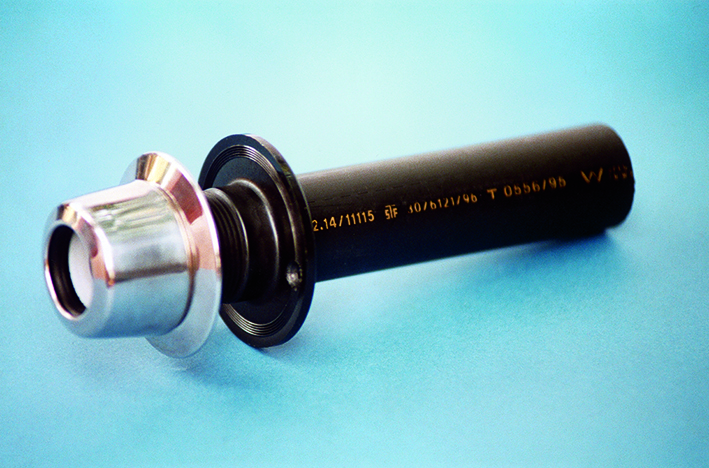
Figure C.1. Waste outlet coupling. The waste pipe has a thread and flange with which it is fixed to the wall.
Reinforcement Strips
These are strips for reinforcement/sealing sheet joints, transitions between floors and walls, used when applying a waterproofing membrane.
The strips are often about 100 mm wide and made of fabric which sometimes has a rubber coating.
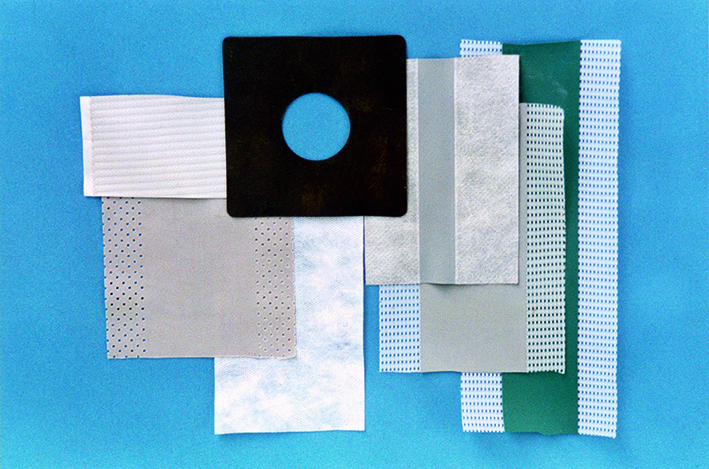
Figure C.2. Waterproofing tape. At the top, a rubber sealing collar with a punched hole for pipe penetrations.
Backslope (Bagfald)
A slope in the opposite direction than that intended. This term is typically used to describe a slope away from a floor gully.
Facing (Beklædning)
Facing refers to wall coverings (e.g., tile facing).
Flooring (Belægning)
Flooring refers to floor coverings (e.g., PVC flooring)
Bend Support (Bukkefix)
This term refers to a piece of angled metal with tabs to support and fix a water pipe. It also refers to a retainer in two halves which is tightened around a pipe. It is used to retain pipes and designed to be fixed to a substrate.
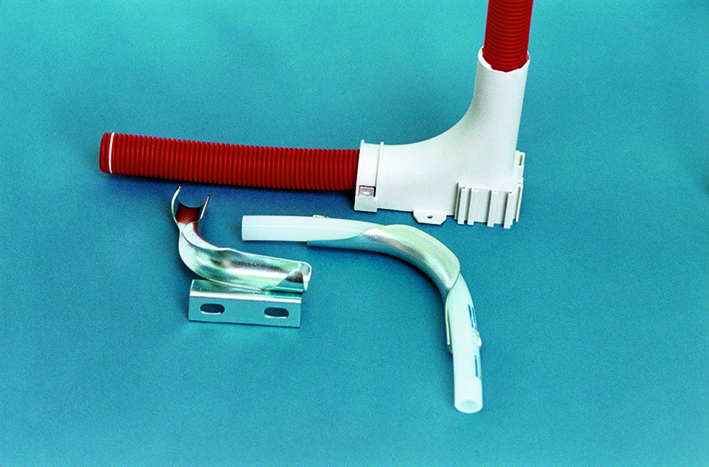
Figure C.3. Bend support in plastic and metal.
Backstop (Bundstop)
A strip of polyethylene, or similar closed-cell material. A backstop is used when sealing with resilient sealant. It functions partly as a substrate for the sealant and partly to avoid (to block) adhesion at the bottom of the joint.
Rupture Strain (Brudtøjning)
The relative elongation of a material immediately before a rupture occurs.
Collar Bush (see Pipe sleeve)
EPDM
Rubber material used in various combinations and designs, such as roofing underlay and joint profiles.
ETA
ETA stands for European Technical Approval. An ETA approval issued for a waterproofing system (e.g., a waterproofing tile setting system), documents that the system is suited for use in wet rooms. However, checks should still be made to ascertain that national (Danish) requirements are met (e.g., for Z-value and membrane film thickness).
Liquid Membrane (Flydende membran)
Material applied in liquid form that forms a watertight membrane when dried out or cured.
Offset or Cranked (Forkrøpning)
A cranked or offset pipe or channel is installed when it is impossible to make a straight connection. This usually results in more flow resistance within the pipe.
Additional Wall (Forsatsvæg)
A wall erected in front of an existing wall (which is not suitable for use as a wet room wall).
Humid Zone (Fugtig zone)
The wall area in a wet room outside the wet zone. Here, heavier impact is anticipated than in other rooms, such as high relative humidity and occasional water exposure (see Figures 2 to 6 in Section 1.5, Wet-Room Zones).
Moisture Content (Fugtindhold)
Moisture content in wood is usually calculated as the percentage by weight of moisture or water relative to the dry weight of the wood. For other building materials, moisture content is usually denoted by the relative humidity with which the given material is in equilibrium. This is designated as the equilibrium moisture content (EMC).
Flashing (Inddækning)
Flashings are watertight joints between building parts. In the context of wet rooms, flashings refer to the watertight joints between floors and walls.
Tight-Fitting Joint (Knasfuge)
Tight-fitting joints are the joints between tiles without tile grout or sealant.
Supply Outlet Box (Koblingsdåse)
A watertight box mounted within walls having an angled fitting inside. The angled fitting connects the PEX supply pipe with the specific fixture or drain valve. Supply outlet boxes are designed to include empty conduit solutions. Therefore, there will be a coupling for the empty conduit.
Compression Fitting (Kompressionssamling)
These are pipe couplings where a watertight coupling is obtained by compressing a brass ring around the pipe when tightening a union with an inside conical surface.
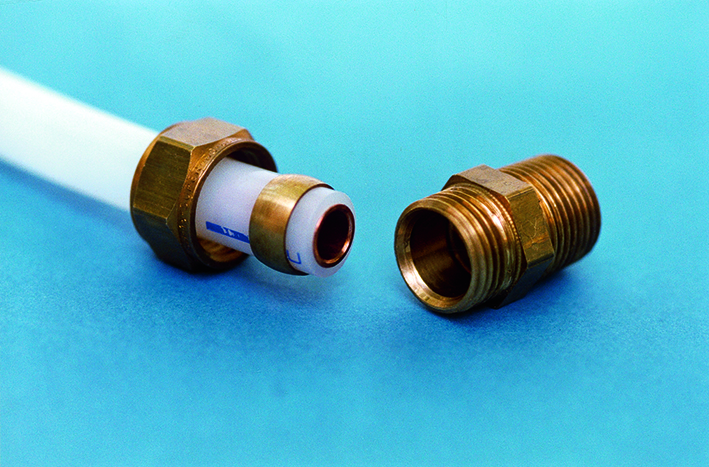
Figure C.4. Compression fitting with PEX pipe. When tightened, the brass ring is pressed into the seat between two conical planes.
Tapered Falls (Kuvertfald)
These are falls in floor surface areas divided into small plane areas abutting along straight lines. In the context of wet rooms, these include falls towards the floor gully (see Figure 32 in Section 3.3.3, Constructing Falls).
Depression (Lunke)
This is a local depression in the floor surface.
Nogging (Løsholt)
A nogging is a metal profile or batten length inserted between two studs which is also known as a cross strut.
Wall-Mounted Coupling (Montagekobling)
This is a special compression fitting between pipes and fixtures/drain valves. Wall-mounted couplings are designed so that the pipes are connected outside of the wall construction. This means that any leakages will appear on the front of the wall. Wall-mounted couplings are used for both copper and PEX pipes (the latter is only intended for cold water). Examples of wall-mounted couplings are shown in Figures 93 and 98 in Section 8.2, Water Supply Installations.
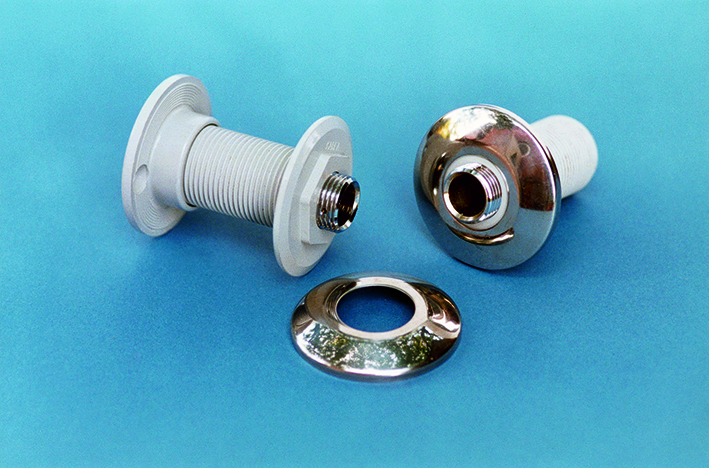
Figure C.5. Wall-mounted coupling. The fitting on the left includes a flange for fixing.
Union (Omløber)
A union is a fitting with internal thread used for coupling pipes.
O-Ring
This is a circular rubber ring (often with a circular cross section) used to make (pipe) connections tight.
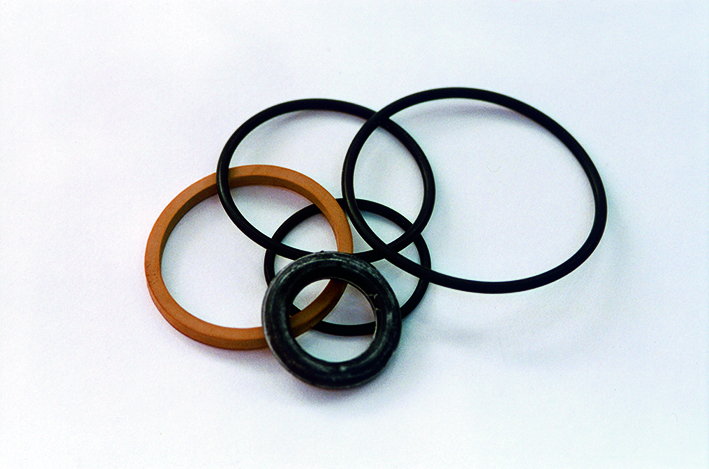
Figure C.6. . O-rings in various dimensions.
PE Foil (PE-folie)
PE foil is plastic foil made of polyethylene. It is used as a watertight layer in wet room constructions where the thickness must be min. 0.20 mm to ensure adequate strength. One should only use foils with documented long lifespans (e.g., tested according to SPF-Verksnorm 200/2001).
PEX Pipes (Pex-rør)
These are plastic water pipes used for water supply and heating installations.
Primer
A primer is a liquid product applied when waterproofing and sealing to bind dust and improve adhesion.
Pipe Sleeve (Rørbøsning)
A piece of threaded steel pipe or an empty conduit with a union, and a pipe penetration seal, both fitted with O-rings. When the seal and union are tightened a seal between the pipe, floor, or wall surface is achieved.
The pipe sleeve is fixed by embedding it. Alternatively, a wall stay fitted to the opposite end of the sleeve will keep the pipe fixed. The empty conduit can be fixed with a bend support. Examples of collar bushes are shown in Figure 91, Section 8.2, Water Supply Installations.
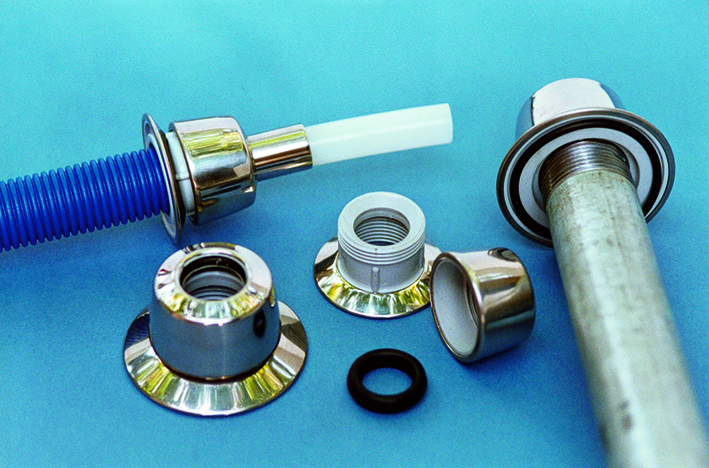
Figure C.7. Pipe sleeves. The left sleeve has a PEX pipe in an empty conduit, and the right sleeve has a steel pipe.
Bond-Breaker Tape (Sliptape)
Bond-breaker tape is tape placed at the bottom of a joint prior to sealing with resilient sealant to prevent the sealant from bonding to the bottom of the joint.
Empty Conduit (Tomrør)
Pipe through which water pipes are run for extra protection against water damage. Empty conduits are essentially corrugated plastic tubing and they are used in conjunction with PEX pipes.
Cross Strut or Nogging (Travers eller løsholt)
This is a profile or piece of sheeting inserted between two studs, especially for the purpose of fixing wall-mounted couplings, washbasin fixings, etc.
Trimmer/Trimmer Joist (trempel)
This is a short beam connecting two trimmer joists.
Sealing Collar (Tætningsmanchet)
A piece of fabric, sometimes with a rubber coating, with a hole at the centre fitting tightly around pipe or waste outlet.
Subfloor (Undergulv)
This is the part of the floor underneath the finished floor covering. It is also known as a counter floor.
Trimmer Joist/Travers (Veksel)
This is a beam inserted between longitudinal floor joists. Taverses/trimmer joists are used when support is required across the joists or for supporting joists which cannot be installed continuously (see Figure 39 in Section 3.4.1, Build-Up).
Wet-Room Paint System Kit (Vådrumsmalesystem)
A paint application system which meets the requirements for obtaining an ETA or MK approval (see Section 6.4.1, Approvals for Paint Applications). Such requirements include waterproofing, water-vapour diffusion resistance factor (Z-value), adhesion, layer cohesion, and resistance to shocks and blows. The requirements for paint application kits are specified in MK 7.00/012, Vægbeklædninger til vådrum. MK prøvnings- og godkendelsesbetingelser (Wall Coverings for Wet Rooms. Conditions for MK Testing and Approvals) (ETA-Danmark, 2014b).
Wet Zone (Vådzone)
The area of a wet room regularly exposed to water. These carry strict requirements for construction, materials, and surface finishes (see Figures 2 to 6 in Section 1.5, Wet-Room Zones).
Water-Vapour Diffusion Resistance Factor/Z-Value (Vanddampdiffusionsmodstand/Z-værdi)
This is the numerical value for the resistance of a material or a construction to the passage of water vapour by diffusion. It is measured in GPa s m2/kg.