5 Renovating Existing Bathrooms
This section describes the renovation of existing wet rooms, especially bathrooms, whose ages can vary widely. The same guidelines apply to other wet rooms. The section also sets out how to modernise old constructions.
Constructions in old bathrooms often differ considerably from those in new bathrooms. Materials and structural designs reflect the time of construction and the regulations and sensibilities applicable at that time. Bathrooms constructed at the same time as a building should be distinguished from those added later.
Further information on old constructions is available at the following link: www.danskbyggeskik.dk.
5.1 Renovating Bathrooms – Principles
As a rule, existing wet rooms erected legitimately according to applicable rules and recommendations at the time of construction will remain legal later in time.
When carrying out renovation work, it is important to assess whether this will constitute a major or minor intervention, as this determines whether current legislation must be followed or not.
- For major operations in existing bathrooms (e.g., where the floor construction is changed from terrazzo to tiles or where new walls are built) current rules apply. New walls must meet current requirements for construction design and waterproofing. For example, a waterproofing membrane must be installed, possibly with a new concreting substrate to achieve the correct thickness of bathroom floors in multistorey buildings where floor constructions are changed from terrazzo to tiles.
- Minor operations can, on the other hand, be implemented without having to adhere to current legislation. There is no requirement for fitting a waterproofing membrane when replacing floor tiles. Similarly, replacing sanitary installations or soil stacks does not require adherence to current legislation, but watertightness must be retained.
When renovating, one should take the changes in the usage of bathrooms that have occurred over time into account. For example, baths and showers have become more frequent fixtures and last longer than their antecedents. Constructions previously considered watertight may not be watertight in present-day usage. It is always therefore recommended to improve watertightness when renovating old bathrooms (e.g., fitting a waterproofing membrane when replacing the tiles).
5.2 Estimating the Extent of the Renovation Project
Prior to renovating bathrooms, one needs to examine how existing constructions and installations are designed (e.g., based on descriptions or drawings). Information is not always easy to come by but can sometimes be obtained from construction project archives. In some cases this can be accessed from www.weblager.dk.
Renovating bathrooms also covers relatively recent bathrooms, such as light-grade floor constructions built when bathrooms were added to old multistorey buildings. For major operations in these constructions, it will often be necessary to change the construction design to a cast deck on a timber joist construction. This is because formerly common, light-grade constructions are no longer permitted according to current legislation, unless they are built as listed in table 3.
In renovation work, it might be necessary to assess:
- The strength and rigidity of constructions
- The condition of installations
- How constructions can be integrated
- How easily construction and installations can be integrated
- Part renovations
- Wall and floor coverings.
The Strength and Rigidity of Constructions
Does renovation result in stricter requirements for strength and rigidity of the constructions? There are stricter requirements for the rigidity of a tiled floor than for a PVC floor, meaning that changing the type of covering may necessitate changing the construction design.
Condition of Installations
In many renovation tasks, the installations (water, waste, heating, ventilation, and electricity) are old. One should consider whether to replace the installations and perhaps relocate them during the renovation to ensure that they meet present-day standards, thus avoiding future costly repairs due to wear and tear.
Integrating Constructions
Investigations should be made as to how new and old constructions can be integrated. The solutions should be described or drawn for contractors to use.
Integrating Construction and Installation
Changing the constructions may have a significant impact on installations and vice versa. Problems could arise when connecting a new floor covering to an existing pipe or an existing floor outlet. If a terrazzo or PVC floor covering is changed to tiles,
it will be necessary to replace the floor outlet with a type suitable for tiles because the existing floor outlets cannot be adapted for use with tiles.
Flashing around pipes, and other protrusions, must be executed according to the guidelines for new builds (see Section 8, Plumbing Installations). If this proves impossible, a pipe guard or installation shaft must be built and safely flashed against the floor. Joints, meters, or similar elements that are fixed to water pipes must be accessible via an inspection hatch.
Part Renovations
When renovation is restricted to parts of a wet room, care must be taken to make the joints with adjacent building parts watertight. This might call for minor interventions being made to adjacent building parts (e.g., moving pipes, or making pipe guards).
If solely changing the wet room floor, the watertight flashing against the walls and penetrations must be constructed according to the guidelines for new wet rooms. In the case of tiled walls, it will normally be necessary to remove the bottom row of tiles on the wall to establish watertight flashing, including a watertight joint with existing walls. Flashing is also important in part renovation work, meaning that it should extend min. 60 mm up the walls and 60 mm across the floor (preferably 100 mm, as for new builds).
Pipe penetrations in the floor are waterproofed with sleeves and/or a waterproofing membrane. Pipe penetrations placed close to walls can be difficult or impossible to make watertight. Instead, they should be concealed by a pipe guard or moved.
Surface Coverings
As a rule, existing surface coverings are removed (e.g., tiles). However, existing tiles can be left on the walls and new ones installed on top of them, taking care to allow for wall sockets, door frames, etc. If removing tiles from plasterboard, the boards are likely to break and must be replaced.
The floor is more critical because the floor outlet must be flush with the floor surface. Consequently, laying tiles on top of existing tiles is not an option around an existing floor outlet because the outlet will no longer be flush with the floor surface. In that case, the floor outlet must be replaced.
5.3 Floor Constructions
5.3.1 Bathrooms Built When the Building was Constructed
For bathrooms made when the building was erected, deck constructions are likely to be made from inorganic materials such as concrete or lightweight concrete. In old constructions, the decks may have been constructed as iron joist constructions with the space between the joists concreted (see Figure 71). Old constructions also include hollow-core brick slabs, and other similar materials.
On this kind of inorganic deck, renovations can be carried out according to the guidelines that apply to new wet rooms with heavy-grade deck constructions. However, the condition of the existing deck must be assessed prior to renovation. The bearing strength could be reduced for iron joist constructions with cast concrete if iron joists show signs of corrosion. This is particularly likely to be the case if the old floors were leaky, potentially due to a cracked terrazzo covering. Furthermore, the concrete above and between iron joists is often of an inferior quality and deck layers above iron joists are often inadequate. Therefore, it may be necessary to recondition the construction when renovating.
If a terrazzo floor is changed to a tiled floor, the floor outlet must be changed to a type suited to the new floor covering. In multistorey buildings with a load class M classification, waterproofing membranes must be installed when renovating. Terrazzo floors cannot be installed with a waterproofing membrane. Instead, the assumption is that when renewing a terrazzo floor, the underlying concrete is watertight.
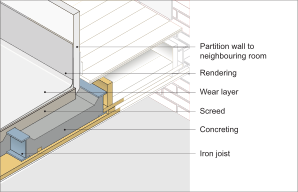
Figure 71. A section of floor construction in a bathroom in old property with iron joist construction. In this example, the floor is shown from a side without a supportive wall. There is concrete between the joists and a mortar screed bed. The floor construction finish is a watertight wear layer, such as terrazzo.
5.3.2 Bathrooms Built After the Building was Constructed
Originally, many old buildings did not have bathrooms and these were often added later.
A typical dated floor construction is concrete on timber joists. Originally, the concrete was laid on a watertight layer of bituminous roofing felt laid on pugging boards, reinforced longitudinally by boards. The bituminous felt layer was continued up the timber joists.
Reinforced concrete was cast over the joists in a layer 80 mm thick and to a height of 50 mm above the upper sides of the joists. The floor outlet was embedded with a spacing of min. 100 mm to adjacent joists or traverses/trimmer joists. This was finished with a screed layer and a floor covering (see Figure 72).
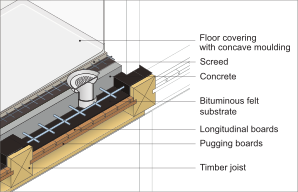
Figure 72. A section of floor construction in old bathroom construction with in situ concrete on existing timber joists. A longitudinal reinforcement layer of boards is placed over the pugging boards. A watertight layer of bituminous felt is placed on top of boards and joists, which is then concreted over with reinforced concrete. The thickness of the concrete layer had to be min. 80 mm, and min. 50 mm above the joists. Mortar screed is placed on top of the concrete and finally the floor covering, finished at the corners with a concave moulding.
Floors with in situ concrete on timber joist constructions could also have been constructed differently (see SBi Guidelines 169) (Brandt & Woetmann Nielsen, 1991). The year of building can provide information about the construction method used.
Old, heavy-grade, in situ constructions of concrete on timber joists can be renovated according to currently applicable guidelines for floors on concrete, provided that no major changes are made.
Furthermore, bathrooms could formerly be constructed using a seamless covering directly on an existing timber floor. The thickness of the covering had to be min. 32 mm and floor outlets had to be embedded (see Figure 73). The floor was subsequently nail-fixed and subsequently large-head nails were added with spacing of approx. 50 mm. Finally, the flooring was laid with a thickness of min. 25 mm. When renovating this kind of construction, it is always necessary to alter the construction to meet contemporary requirements.
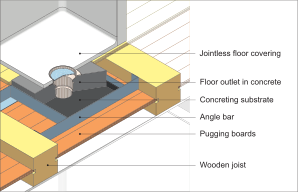
Figure 73. Section of floor construction in old bathroom built as a seamless floor laid on old floorboards on timber joist construction. The floor outlet is embedded, and the weight of the concrete slab is transmitted to the joists using two angle bars fixed between the joists.
Recent light-grade floors may be constructed very differently. Information on such floors is available from earlier SBi Guidelines, accessible on www.anvisninger.dk or www.danskbyggeskik.dk. If the actual construction is not interfered with, the renovation of floors on light-grade constructions can, as a rule, be done according to the guidelines for floors on new light-grade floor constructions.
As a rule, new floor coverings can be laid on top of existing ones if the new covering can be connected correctly to the floor outlet. However, this is rarely possible, and it will usually be necessary to replace the outlet to ensure that it is flush with the new floor surface. According to DS 432 Wastewater installations (Danish Standards, 2009b), it is not permitted to raise an existing old floor outlet (see Section 8, Plumbing Installations and the BYG-ERFA info sheet
(50) 10 11 30, Vådrum – gulvafløb og afløbsledninger (Wet Rooms – Floor Outlets and Discharge Pipes) (Byg-Erfa, 2010)).
5.4 Wall Constructions
5.4.1 Bathrooms Built When the Building was Constructed
In bathrooms built when an old building was constructed, wall constructions usually comprise of inorganic materials. In more recent buildings, the walls may be built as stud walls, including timber stud walls. When renovating brick, concrete, lightweight concrete, or stud walls, the guidelines for new walls of the same type can be followed.
In addition to the traditional constructions such as brickwork, concrete, and lightweight concrete, the walls can typically be built as breeze-slab walls or as Monier partition walls.
Breeze-Slab Walls
Breeze-slab walls consist of cast slabs of cement and crushed coke cinders. The slabs normally measure 500 × 670 mm and are 50 mm or 60 mm thick. They are grooved on all four edges and usually bricked up using a lime-cement mortar with joints approx. 1 cm thick. Horizontal joints incorporate 5 mm core rods. The walls are normally rendered on both sides. If there are cracks in the rendering, this might be due to insufficient rigidity, or the walls having settled. Breeze-slab walls which are not sufficiently strong or rigid will usually have to be replaced by new walls. Breeze-slab walls must not be weakened through the incorporation of pipes or other elements.
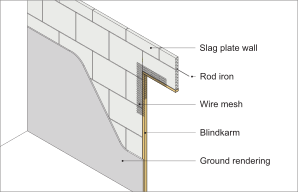
Figure 74. Breeze-slab walls (coke walls) and Monier partition walls (not shown) are examples of old partition walls which are water-absorbent despite commonly being used in bathrooms. Originally, these wall types were merely required to be water-repellent to a height of 1.8 m above floor level. When renovating, these walls should be waterproofed, ideally with sheet facing and watertight covering.
Monier Partition Walls
Monier partition walls are cast in cement mortar or concrete and reinforced with crossed core rods. The walls are rendered on both sides. Formerly used as bathroom walls 50–80 mm thick with oil paint or tiles as surface finish. If there are cracks in the rendering, this might be due to insufficient rigidity, or the walls having settled. Monier partition walls which are not sufficiently strong or rigid will usually need additional walls or would need replacing.
Renovating and Surface Treatment of Breeze-Slab and Monier Partition Walls
Slag plate or Monier partition walls were originally approved for use in wet rooms if they received a water-repellent surface application to a height of 1.8 m above floor level. However, these walls are water-absorbent and when exposed to water can transport moisture to adjacent rooms and building parts, such as timber joist constructions. Monier partition walls and breeze-slab walls should therefore be renovated according to the same guidelines as board partition walls and half-timbered walls (see Section 4.3.5, Anvendelse af eksisterende vægge).
For renovation tasks, plasterboard, or calcium silicate sheets capable of acting as substrate for watertight facings can be mounted directly to an existing wall in certain cases. This requires the wall to be sufficiently planar, strong, and rigid. At minimum, the existing wall must have the same level of strength and rigidity as a stud wall used as substrate for the sheeting material in question. For strength and rigidity corresponding to a stud wall with a layer of wet room gypsum board, see Section 4.4, Using Existing Interior Walls.
If the strength and rigidity of the walls have been assessed and found satisfactory, at minimum they must be given a watertight covering (e.g., a tile setting system with a waterproofing membrane continued to normal room height).
5.4.2 Bathrooms Built After the Building was Constructed
Many old buildings did not originally have bathrooms and many buildings, have therefore had bathrooms added after construction. Wall constructions in such bathrooms are typically stud walls with sheet facing or inorganic walls (such as lightweight concrete walls).
Inorganic walls are renovated according to the guidelines for corresponding new walls. Stud walls are retained if the actual construction is not interfered with during the renovation. Replacing the final sheet layer is not considered major interference (the sheet layer is easily broken when removing the facing).
As a rule, new facing can be installed on top of an existing legitimate construction/covering (such as a tile-on-tile solution). However, this relies on the correct removal and reinstallation of old penetrations, electrical sockets, and other fixtures.