7 Joints and Ceilings
7.1 Joints
7.1.1 Types of Joints
Joints in wet rooms occur between tiles, building parts, and joints around penetrations. The sealant and width of the sealed joint must be compatible with the purpose and materials being sealed for the joint to achieve the desired function and to be long-lasting. Furthermore, the pointing must be carried out with great care.
Irrespective of how good a joint is, it cannot be expected to remain watertight indefinitely. Therefore, the tightness of a wet room construction must never solely depend on the tightness of a specific sealant but will have to be achieved in some other way (e.g., by fitting a waterproofing membrane).
Two main types of sealants are used for wet rooms, namely flexible mortar joints and resilient/elastic joints.
7.1.2 Flexible Mortar Joints
Flexible mortar joints can be used when anticipating only minor movement between the building parts to be pointed and where fine cracks are deemed acceptable during use. Hence flexible mortar joints can be used in most well-constructed wet rooms with good continuity between floor and walls. For example, there is likely to be only minor movement in brick walls or cast constructions where the majority of the shrinkage and settlement is complete. The same is true of stud constructions with plasterboard or silicate sheets where the stud is safely anchored to the joists or concrete deck.
Flexible mortar joints are used in tile coverings on floors and walls. They are cementitious and synthetic material has been added to the sealant, enabling the cured joint to absorb small deformations. The depth of the joint will typically correspond to the width of the joint between the tiles or the thickness of the tile (see Figure 90). Flexible mortar joints can also be used for irregular joint geometry.
Using flexible joints only carries a minimal risk of damaging the membrane when replacing the joint.
7.1.3 Resilient/Elastic Joints
Resilient joints are used as required for the purpose of impact sound reduction when movement joints are needed (e.g., in connection with movement joints in the underlying construction or where movement is expected between adjacent building parts and around penetrations), which flexible mortar joints are incapable of absorbing. Furthermore, they are used where cracks are unacceptable for hygienic reasons.
Resilient joints must be min. 6 mm wide with a depth of approx. 2/3 of the width. For more information, see www.fugebranchen.dk/fugeguiden
Resilient joints must be made so that the sealant can be replaced (e.g., in the event of mould growth). Such replacements must not damage the watertightness of (e.g., an underlying membrane). The risk of damaging the membrane is great unless the joint is cut out with great care. Prior to sealing, the contact surfaces for the sealant must be stripped and degreased and they must be dry and free of dust.
Requirements for Sealants
Resilient sealants should be selected and used according to manufacturer’s guidelines. Resilient sealants could be silicone-based and must be suitable for wet room use (i.e., according to DS/ISO 11600:1993) (Danish Standards, 1993a). Normally, mould-inhibiting substances are added to sealant whose max. lifespan will typically be 1–2 years relative to usage, ventilation, and cleaning conditions.
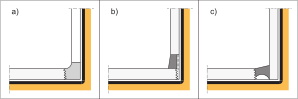
Figure 90. Examples of sealed joints between tiles.
- If only small amounts of movement occur, the sealing can be executed using flexible mortar. The joint shown means that resilient sealant cannot be used as it is not possible to fit a joint substrate after the tiling has been completed and because the joint cannot be replaced.
- This resilient joint is unable to absorb major movement neither horizontally nor vertically. The joint has been fitted with bond-breaker tape as a bond-breaking substrate for sealing. The width should be min. 10 mm; however, when replacing existing sealant, these joints can be min. 8 mm. This joint can also be used as a vertical corner joint.
- This resilient joint is capable of absorbing relatively large movements both horizontally and vertically. An EPDM profile could (e.g., be used as sealing substrate). If thicker floor tiles are used, a circular substrate profile can be used. Round- edge floor tiles involve a risk of water pooling on the joint surface.
Making a Resilient Joint
The joint must be made so that the sealant only bonds with the sides. The width and depth of the joint must not vary significantly. Therefore, resilient joints must be made on a joint substrate placed at the bottom of the joint which the sealant must not bond with (e.g., bond-breaking tape or a semi-circular foam profile) (see Figures 90b and c). Furthermore, the joint substrate is intended to serve as ‘stay’ for the sealant. It is best to install a bond-breaking tape as substrate for the joint before tiling.
7.2 Ceilings and Dropped Ceilings
Ceilings in wet rooms must normally be made airtight to prevent warm, humid air from infiltrating the constructions above. This could be achieved using sheet facing installed with airtight joints against the walls.
No vapour-retarding layers must be installed in ceilings between two wet rooms because such layers may collect water and thus delay the detection of leakages in wet room floors above.
Dropped ceilings must be demountable or have hatches, so that concealed installations can be inspected and repaired.
Sloping walls always count as walls in wet rooms.