1 Basic Requirements and Recommendations
Wet rooms are the subject of requirements in the 2010 Building Regulations (Ministry of Transport, Building and Housing, 2010) as well as the Statutory Order on High-Voltage Power (Stærkstrømsbekendtgørelsen) (Ministry of Business Affairs, 2001). Moreover, there may be supplementary surface requirements for wet rooms (e.g., in the food industry). This Section explains the Guidelines in relation to applicable legislation, including the Building Regulations.
The Building Regulations stipulate special provisions for floors and walls in those parts of wet rooms exposed to water. For practical reasons, wet rooms are subdivided into two zones relative to their exposure to water: a wet zone and a humid zone. This Section explains how to subdivide wet rooms into wet zones and humid zones, how to select load classes, how to design wet rooms, and how to implement a wet room project.
Provisions for wet rooms in the Statutory Order on High-Voltage Power (Stærkstrømsbekendtgørelsen) (Ministry of Business Affairs, 2001) are detailed in Section 8.4, Electrical Applications – Zoning.
1.1 The Guidelines and Legislation
1.1.1 Are the Guidelines Part of the Legislative Provisions?
SBi Guidelines are not part of the legislative framework but are regarded as ‘required common technical knowledge’. For further general information, please consult www.anvisninger.dk.
Building regulation provisions for wet rooms stipulate that suitable waterproofing systems be used for stud walls and for floor and wall constructions containing wood or other organic materials (i.e., systems whose essential performance requirements for wet room constructions are documented). The waterproofing systems mentioned in these Guidelines can be used without further documentation and the same is true of systems with an MK approval or an ETA (European Technical Assessment), which meet Danish requirements (this could be a specific approval of a waterproofing system).
1.1.2 Relevance to Previous Legislation
The first Building Regulations dating from 1961 and 1966 stipulated that wet room constructions be built of water- and moisture-proof (i.e., inorganic) materials or be approved by the Ministry of Housing. However, when designing wet rooms in existing buildings, it was possible to retain existing timber joist constructions, on condition that the flooring was watertight.
Following the publication of SBi Guidelines 89 in 1971, the use of PVC flooring on organic substrates was permitted. Similarly, after the publication of Building Regulation provisions from 1972 to 1998, light-grade constructions (such as stud walls with gypsum board facing and timber joist constructions) were permitted in wet rooms. Moisture-sensitive constructions thus had to be constructed in accordance with directions and guidelines approved by the ministry responsible or had to use products with specific approval (a so-called MK approval). Provisions for installing light-grade constructions such as walls and floors covered with sheeting on timber joist constructions have been upheld since then, although they are not specifically mentioned in the first Building Regulations for small houses from 1985.
Consequently, constructions which did not meet the above provisions could neither be seen to comply with the legislation nor be described as good practice.
SBi Guidelines on wet rooms have always been accepted by the ministry responsible as constituting good building practice and wet rooms built according to these guidelines were considered to meet Building Regulation provisions and be consistent with good practice.
1.1.3 Solutions in the Guidelines are Documented
Moreover, the solutions in these Guidelines can be used in conjunction with, or in place of, products and constructions subject to an approval (such as the MK approval or ETA (European Technical Assessment) adapted to national Danish requirements) (see Annex E. Marking and Approvals). This includes stud walls and floor and wall constructions containing wood or other organic materials.
Constructions of inorganic materials must comply with general provisions for watertightness and damp-proofing, but the Building Regulations do not offer any specific provisions for how such constructions should be built. These Guidelines illustrate how constructions made with inorganic materials can be built to comply with general Building Regulation provisions (see Section 2.2, Floor and Wall Performance).
The Guidelines provide a general overview of floor and wall constructions applicable in wet rooms.
In addition to the solutions mentioned in the Guidelines, other solutions exist (e.g., prefabricated walk-in showers or installation frames). These solutions are usually applied, assuming their compliance with applicable performance requirements (notably that of being watertight) is documented (see Section 2.2.2, Watertightness). Documentation that prefabricated wet rooms or water supply and sanitary installation units comply with applicable performance requirements can be obtained by testing them according to the methods used to test wet room constructions or waterproofing systems requiring an MK approval or an ETA.
1.2 Building Regulation Provisions
Wet rooms must be constructed in accordance with applicable Building Regulations at the time of construction (cf. the 2010 Building Regulations, (BR10) (Ministry of Transport, Building and Housing, 2010)). The Building Regulations set out general provisions that materials and constructions should be suitable for their purpose, be durable, that solutions be buildable, and should have a long lifespan. Additionally, the Building Regulations specifically contain a chapter on wet rooms.
The relevant parts are reproduced here:
3.3.2 Bath and Toilet Rooms
§ 1
In dwelling access decks, at minimum, there must be 1 toilet room with step-free access, and appropriate facilities of appropriate size.
(3.3.2 (1) Explanatory Text
Requirements are met when there is a clearance in front of fixtures such as washbasin and toilet of min. 1.1 m. Increasing this distance will increase comfort and user-friendliness.
For appropriate facilities in respect of persons with physical impairment, see SBi Guidelines 222 Tilgængelige boliger (Accessible Dwellings).
§ 2
A washbasin must be installed in toilet rooms or in an anteroom.
4.5 Moisture and Durability
§ 5
Wet rooms (including bathrooms, utility rooms, and toilet rooms with floor gullies) must meet the following requirements:
- Floors and walls must be built to resist moisture exposure and the mechanical and chemical load that normally occurs in wet rooms.
- Floors and flooring (including joints, connections, pipe penetrations, etc.) must be watertight.
- Walls and facings (including joints, connections, pipe penetrations) must be watertight in the part of the room exposed to water.
- Water on the floor must be drained off to a floor gully.
- In the parts of the wet room regularly exposed to water, no pipe penetrations shall be made in the floor.
- For stud walls as well as floor and wall constructions with wood or other organic materials, a suitable waterproofing system must be used.
(4.5 (5) Explanatory Text
Note that toilet rooms without floor gullies are not considered wet rooms.
Areas in and around shower stalls and bathtubs are assumed to be regularly exposed to water.
The guidelines By og Byg Anvisning 200 detail how floors and walls in wet rooms can be constructed. Furthermore, they show examples of planning, design, and construction of bathrooms in new and old dwellings.
6.3.1.2 Residential Buildings
§ 1
The fresh-air supply in residential rooms as well as the residence, generally, must be min. 0.3 l/s per m2 of the heated floor area.
§ 2
Fresh-air or mechanical ventilation can be used for single-family houses. Section 3 applies for single-family dwellings with mechanical ventilation.
(6.3.1.2 ( 2) Explanatory Text
Bath and Toilet Rooms
Air supply: min. 100 cm2 opening facing access space.
Furthermore, if the room faces an exterior wall, an openable window, hatch, or exterior door.
Air exhaust: ventilation duct measuring min. 200 cm2 across.
Separate Toilet Rooms and Utility Rooms
Air supply: min. 100 cm2 opening facing access space.
Furthermore, if the room faces an exterior wall, an openable window, hatch, or exterior door.
Air exhaust: ventilation duct measuring min. 200 cm2 across.
§ 3
In addition to the performance standard in Subsection 1, in residential buildings (other than single-family houses with natural ventilation) the basic air exchange of residential units must be performed via ventilation systems using heat recovery, injection into residential rooms, and extraction in bath and toilet rooms, kitchen, and utility rooms.
In summer, injection can be replaced by fresh-air supply via windows, air vents, etc.
§ 4
In residential buildings other than single-family dwellings with natural ventilation, demand-controlled ventilation can be used if the air exchange rate will not drop below 0.3 l/s per m².
(6.3.1.2 (4) Explanatory Text
In dwellings, demand control will usually be relative to moisture conditions. Demand-controlled ventilation may include a manually operated cooker hood.
§ 5
Furthermore, air exchange rates (in kitchens, bath and toilet rooms, utility rooms, etc.) should, at minimum, be adjustable to the following extraction volumes: in kitchens, 20 l/s and in bath and toilet rooms, at least 15 l/s.
In separate toilet rooms, utility rooms, and basements, an extraction volume of 10 l/s is required.
(6.3.1.2 (5) Explanatory Text
In a dwelling measuring 65 m² with 1 kitchen and 1 bath/toilet room, the ventilation should be adjustable to 0.54 l/s pr. m². This is significantly more than the basic air exchange in Section 1 (0.3 l/s pr. m²).
In a dwelling measuring 110 m² with 1 kitchen and 2 bath/toilet rooms, the ventilation should be adjustable to a total capacity of 0.45 l/s pr. m².
1.3 How to Interpret Building Regulation Provisions
The following comments relate to Building Regulation provisions. The numbers refer to the respective sections in BR10.
3.3.2 Bath and Toilet Rooms
The provision shall ensure that wet rooms are designed to be accessible to everyone (see Section 1.7, Accessibility and SBi Guidelines 249, Tilgængelige boliger – indretning (Accessible Dwellings –Layout) (Sigbrand & Jensen, 2015)).
4.5 Moisture and Durability
§ 5 (3): The part of the room exposed to water refers to those areas likely to be directly exposed to water (e.g., when showering or cleaning). All floor areas are regarded as exposed to water load. All wall areas less than 2 m away from shower, bathtub, or washbasin are considered exposed to water load (at least occasionally). Note that the area of the wet room exposed to water load is not identical to its wet zone, where regular (often daily) exposure to water is expected. In the entire room, wall areas and pipe penetrations must be sufficiently watertight to prevent moist air from infiltrating moisture-sensitive constructions. In practice, therefore, all walls should be made watertight and should have watertight pipe penetrations.
§ 5 (4): Draining water to a floor gully means that no back slope or depressions (which cause ponding) are permitted anywhere on the floor. Hence floors must be constructed with slopes to avoid the risk of ponding. Ponding is defined as water accumulations extending beyond 250 mm (upper limit) or deeper than 1 mm. If this is unclear, the slope should be tested by pouring water onto the floor and measuring the extent and depth of depressions after 5 minutes. See Hvor går grænsen? (Where’s the Limit?) Murerfaget (Danish Construction Association, 2014) and Fliser på væg og gulv (Floor and Wall Tiles) (Brandt, 2006).
§ 5 (5): Floor areas expected to be regularly exposed to water are those around the shower stall, bathtub, and floor gully (see Figures 1–11).
§ 5 (6): Waterproofing systems are considered suitable if they are included in these Guidelines or have received an approval adapted to national Danish provisions (e.g., an MK approval or an ETA (European Technical Assessment)) (see Annex E. Marking and Approvals).
6.3.1.2 Residential Buildings
A distinction is made between single-family houses where natural ventilation can be used and other buildings where mechanical ventilation is a requirement.
In single-family houses with natural ventilation, openings for fresh-air supply and extraction of humid indoor air must, be sized as specified in the explanatory text in the Building Regulations.
In other buildings such as multistorey buildings, demand- or moisture-controlled ventilation can be used. In buildings with several wet rooms, the upshot of this rule is that normally individual extraction can be controlled for each room or extraction can be controlled by the wet room with the highest humidity.
1.4 When do Building Regulation Provisions Apply?
Building Regulations and hence the provisions for wet rooms apply to both new buildings and to significant conversions or extensions. Minor alterations, such as replacing tiles in existing wet rooms, are exempt.
Situations may occur (e.g., geometric limitations, old timber joist constructions, and existing board partitions) which require special attention (see Section 2.3, Constructing Bathrooms in Old Houses).
When renovating existing bathrooms, constructions that were legitimate at the time of construction may remain in use. However, some old constructions such as painted slag plate walls are not as watertight as more recent wall types, including concrete walls or walls fitted with waterproofing membranes. The watertightness of such constructions should therefore be improved when renovating (e.g., by fitting a waterproofing membrane) particularly as contemporary water loads tend to be heavier than in the past (see Section 5, Renovating Existing Bathrooms).
The Byggeskadefonden recommends using wet room solutions specified in the Guidelines for in social housing of load class H (heavy) and M (medium) (see www.bsf.dk/erfaformidling/anbefalinger/installationer/vaadrum/).
Brick or lightweight concrete walls absorb water and should therefore always be fitted with a waterproofing membrane in wet zones (e.g., in and around shower stall and bathtub).
Changes always require vigilance despite initially seeming minor in many cases. For example, replacing PVC flooring with tiles does not always constitute a minor change. This is because tile flooring requires a more rigid substrate, which must be replaced if it fails to meet the requirements in Table 4, Section 3.3.2, Timber Joist Constructions and Subfloors. Furthermore, replacing PVC flooring with tiles would normally require the gully to be replaced as well (see Section 3.3.5, Floor Gullies and Plumbing Installations).
As a rule, installing a new layer of tiles on top of existing wall or floor tiles will is legitimate. Installing a new layer of tiles on an existing floor will normally require the installation of a new gully because the latter is required to be flush with the floor surface (see DS 432, Norm for afløbsinstallationer (Code of practice for Sanitary Drainage - Wastewater Installations) (Danish Standards, 2009b). Existing floor gullies must not be raised using concrete, plastic frames, and other materials listed in Section 8.3, Wastewater Installations.
1.5 Wet-Room Zones
Wet room zones include floors and walls. They do not include ceilings. Provisions for walls in wet rooms only apply when there is a risk of the walls being exposed to water (i.e., in wet rooms with showers).
1.5.1 Wet Zones
The wet zone includes parts of the room regularly – often daily – which are directly exposed to water. These are governed by the strictest requirements for construction, materials, and surface finish.
Wet zones includes:
- the whole floor
- the bottom 100 mm of all walls
- walls near to shower stalls, bathtubs, and washbasins with shower mixer
Shower Stalls
Shower stalls are defined as shower areas, corners, and actual stalls that are walled on three sides. The shower stall or shower area will typically be delimited by a shower curtain, screen, or glass door. A standard shower stall will usually measure 800 × 800 mm or 900 × 900 mm. It can also be circular or have different measurements relative to the surrounding architecture (e.g., 700 × 900 mm, 600 × 1000 mm).
If the shower is located centrally on a long wall, the actual shower area is estimated to extend 450 mm either side of the shower unit while the wet zone extends a further 500 mm either side of the shower unit. This means that the wet zone extends as far as 950 mm either side of the shower unit.
The width of the room will determine whether the wall opposite the shower unit should be included in the shower area (see Figure 1). If the room is narrower than 1.3 m, the opposite wall will form part of the shower area and all walls in the room are treated as part of the wet zone (see Small Wet Rooms).
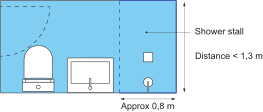
Figure 1. The shower area or shower stall includes the area around the shower unit. It will typically be delimited by shower walls, screens, shower curtains, or shower doors. If the room is narrower than 1.3 m as shown in the figure, the opposite wall is considered part of the shower area and all walls in the room are considered within the wet zone.
On the walls, the wet zone extends as far as the ceiling. In very high rooms, the area above normal ceiling height (i.e., min. 2.3 m) can be considered a humid zone (See Figure 2 in Section 1.5.2, Humid Zones).
If permanently fixed screens are fitted tightly against the walls, these will delimit the wet zone on the walls (see Figure 3 in Section 1.5.2, Humid Zones). Screens can also be installed as doors when they fit tightly against the wall on which they are hung, and reach approximately floor level (i.e., leaving just enough space for the doors to open and shut).
Utility Rooms, Toilet Rooms, and Washrooms
In utility rooms, toilet rooms, washrooms, and similar areas with floor gullies and walls with no anticipated water exposure, the wet zone includes the floor and the bottom 100 mm of all walls. The remaining wall surfaces are not subject to any requirements.
Small Wet Rooms
In small wet rooms (with a floor area of max. 3.25 m2 or a max. width of 1.3 m in the shower area or stall), the wet zone includes all wall surfaces (see Figure 8 in Section 1.5.2, Humid Zones).
Provisions only apply to the bottom 100 mm of the walls in small utility rooms, toilet rooms, and washrooms with floor gullies where walls are not expected to be exposed to water or high relative humidity.
1.5.2 Humid Zones
The humid zone of a room is the area of wall outside of a wet zone. The walls in the humid zone are exposed to humidity to a greater extent than the rest of the rooms in a house due to high relative humidity and occasional water exposure. For this reason, humid zones are also subject to stringent requirements in terms of materials and construction.

Figure 2. The wet zone and humid zone in a wet room with a shower stall. The wet zone includes the whole floor, the bottom 100 mm of the walls, and the wall area within 500 mm of the shower stall demarcation. On the walls, the wet zone extends as far as the ceiling. In rooms with very high ceilings, the area above normal ceiling height (i.e., min. 2.3 m) can be considered part of the humid zone. Water from the floor must be drained off to a floor gully (i.e., the floor should slope towards the gully). The area delimited by the dotted line shows the positions of slopes in the floor where no pipe penetrations are permitted. This area extends 500 mm from the shower stall demarcation. Given that no ponding or back slope is permitted on the floor, it is advisable to lay the floor with slight slopes towards the gully from all directions. Floor coverings or waterproofing membranes must be sealed to the floor gully with a watertight joint.

Figure 3. The wet zone and humid zone in a wet room with min. 250 mm wide permanently fixed screens around shower stall. Screens can also be installed as doors if the doors reach the floor and fit tightly against the wall on which they are hung. The wet zone includes the whole floor, the bottom 100 mm of the walls, and the walls inside the screens. The wet zone extends up the walls as far as the ceiling. In rooms with very high ceilings, the area above normal ceiling height (i.e., 2.3 m) can be considered part of the humid zone. If the floor in the shower stall is separate from the rest of the floor (e.g., if it is recessed) pipe penetrations are permitted immediately outside the screen. Since no ponding or back slope is permitted on the floor, it is advisable to lay the floor with slight slopes towards the gully from all angles. Kerbs, which demarcate wet areas, should be avoided if possible and must not exceed 25 mm in height. If a kerb is used, it will be necessary to install an extra floor gully outside the shower stall to comply with provisions for floor drainage. Floor coverings or waterproofing membranes must be sealed to the floor gully in a watertight joint.
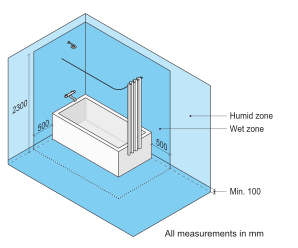
Figure 4. The wet zone and humid zone in a wet room with a corner bathtub. The wet zone includes the whole floor, the bottom 100 mm of the walls, and the wall area within 500 mm of the bathtub. On the walls, the wet zone extends as far as the ceiling. In rooms with very high ceilings, the area above normal ceiling height (i.e., 2.3 m) can be considered part of the humid zone. No pipe penetrations are permitted within min. 500 mm from the tub (marked by the dotted line in the figure). In floor and wall constructions requiring waterproofing, the watertight layer must be continuous and must not be broken or omitted near bathtubs or permanent fixtures. For example, waterproofing membranes and tiles must be continued under and behind the bathtub. Floor coverings or waterproofing membranes must be sealed to the floor gully in a watertight joint.
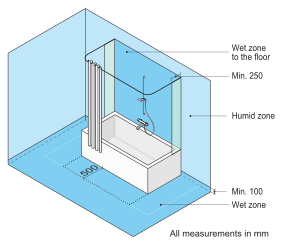
Figure 5. The wet zone and humid zone in a wet room with min. 250 mm wide permanently fixed screens around a bathtub. In this case, only the walls inside the screens count as part of the wet zone and pipe penetrations can be made in the floor immediately outside of the screens. Floor and wall constructions requiring waterproofing must have a continuous watertight layer, particularly around bathtubs and permanent fixtures. Therefore, waterproofing membranes and tiles must be continued under and behind bathtubs. Floor coverings or waterproofing membranes must be sealed to the floor gully with a watertight joint. In very tall rooms, the area above normal ceiling height (i.e., 2.3 m) can be considered part of the humid zone.

Figure 6. Walls near washbasins only count as part of the wet zone if the washbasin fixture includes a shower attachment. In this case, the wet zone extends from the floor to 500 mm above the washbasin and 500 mm outward on either side of the basin. If there is a shower attachment, a floor gully must be installed and the floor must slope towards the gully (in the area delimited by the dotted line). Pipe penetrations must be distanced min. 500 mm from the floor gully. If the washbasin shower attachment is the only shower in the wet room, the rules for shower stalls apply (see Figures 2 and 3).

Figure 7. Utility rooms, toilets, and washrooms with floor gullies are considered wet rooms. However, these rooms will usually only be exposed to water on the floor (incl. the bottom 100 mm of the walls), which comprise the wet zone of these rooms. Water from the floor must be drained off to the floor gully (i.e., the floor should slope toward the gully). The sloping should reach 500 mm from the gully and the remaining floor can be laid horizontally. Since no ponding or back sloping is permitted on the floor, it is advisable to lay the floor with slight slopes towards the gully from all angles.

Figure 8. An example of a small wet room (i.e., smaller than 3.25 m2 or max. 1.3 m wide) where the entire room is a wet zone. In this example, the room measures approx. 1.6 × 1.6 m. In such rooms, the shower stall cannot be effectively screened off and should therefore be placed as far from the door and windows as possible, if they are included in the room (e.g., in the corner between the toilet and washbasin as shown). The doors of small rooms should open outwards to ensure that it can be opened when the room is used by persons requiring assistance.

Figure 9. An L-shaped wet room where the shower is placed in the room’s natural recess. If the room size exceeds 3.25 m2, the wall behind the toilet is included in the humid zone as there is no risk of it being splashed with water during showering. The wall with the window will normally also belong in the humid zone. Whether or not the wall is classed as part of the humid zone depends on the distance between the window wall and the opposite wall in the shower stall. If the distance exceeds 1.3 m, the window wall is classed as part of the humid zone. If the distance is less than 1.3 m, it is classed as part of the wet zone.
1.6 Load Classes
The water and moisture exposure in a wet room depends on how often and how long the wet room is used, ventilation efficiency, and airing. A further determinant is whether wet room surface areas and fixtures are exposed to significant variable mechanical loads in addition to water and humidity. Based on the expected load, a distinction is made between the following wet room classes:
 | Class L (Low): Wet rooms with a low level of exposure to water and humidity (i.e., few daily showers and efficient airing after use). Low levels of exposure to water and humidity apply to, for example, wet rooms in single-family houses, holiday homes for personal use, and buildings with limited usage. |
|---|---|
 | Class M (Medium): Wet rooms with a medium level of exposure to water and humidity (i.e., several daily showers and/or inadequate airing). Medium levels of exposure to water and humidity often occur in low-density housing, multistorey residential buildings, hotels, rental holiday homes, and bathrooms in small and medium workplaces. |
 | Class H (High): Wet rooms with a high level of exposure to water and humidity or where wet room surface areas and constructions are exposed to greater mechanical loads than is usual in homes (e.g., many daily showers, periods with water on the floor, direct splashing of surface areas, or the use of trolleys and mobile appliances). High levels of exposure to water and humidity occur, for example, in common shower rooms in sports centres, restaurant kitchens, catering kitchens, production premises in the food industry, indoor pool areas in single-family houses and holiday homes (see Section 2.4, Wet Rooms Subjected to Heavy Load). |
For wet rooms classed High with very high levels of water load with ponding on the floor for lengthy periods and/or direct powerful high-pressure washing of surface areas, the degree of exposure must be assessed separately and special measures implemented. Particular attention should be paid to penetrations and joints in the wet room construction. Wet rooms with major water load are typically found in highly exposed rooms within certain parts of the food industry.
During planning, design, and construction, a wet room is classed in the wet room category best describing its future use. When in doubt as to which wet room class to use, select the highest of the relevant classes to achieve an acceptable level of protection against water- and humidity-induced damage.
1.7 Accessibility
In dwellings with more than one bathroom and toilet room, the main bathroom should have the greatest degree of accessibility and at least one toilet room must be located at floor level (according to the 2010 Building Regulations, cf. 3.3.2 (1)) (Ministry of Transport, Building and Housing, 2010).
If possible, bathrooms should be laid out to provide access to self-reliant wheelchair users and should be prepared for adaptation to accommodate disabled persons with further needs. Dwellings under the jurisdiction of the Danish Act on Social Housing must be designed to enable disabled persons to use the shower and toilet.

Figure 10. Example of a bathroom and toilet room of dimensions and design ensuring that wheelchair users can use it. The shower stall is positioned to provide the required distance beside the toilet. Measurements comply with those recommended in SBi Guidelines 249, Tilgængelige boliger – indretning (Accessible Houses – Design) (Sigbrand & Jensen, 2015). The wall with the toilet is a humid zone because the shower will not splash water on this wall (the recess depth is assumed to be min. 250 mm).
To ensure optimal design, bathrooms and toilet rooms should measure min. 1.8 × 2.9 m.
If a bathroom and toilet room is used by a self-reliant wheelchair user, it needs to be big enough for this person to be able to use the toilet and washbasin. Accordingly, there must be a turning area of min. 1.5 × 1.5 m.
For users requiring assistance, the toilet should be placed with a free space of min. 0.9 m from one side of the toilet to the wall and other fixtures, allowing space for a carer. This space is also used to park the wheelchair before the user moves to the toilet. Walls behind the toilet should be dimensioned for installing arm rests capable of supporting the full weight of a person.
In front of the toilet, washbasin, and shower stall, the distance to the opposite wall or fixtures should be min. 1.5 m. Retaining a free space of 1.7 m in front of fixtures will provide optimal conditions for a carer to manoeuvre around and assist a disabled person. These dimensions also cater well to other users, as the depth provides space for furnishings (e.g., 0.6 m deep units, washing machines, and tumble driers).
Shower stalls should be min. 0.9 × 0.9 m and can be constructed with a recess max. 10 mm deep. It is advisable to construct the walls in the shower stall to enable the installation of grab rails.
To ensure sufficient strength, it may be necessary to reinforce stud walls if these are installed.
The floor should be easily cleaned and non-slip in dry and wet conditions.
Doors in bathrooms and toilet rooms should have a free opening of min. 770 mm, but preferably 870 mm. This will enable unhindered access for wheelchair users. Doorsteps should be avoided.
Walls should be constructed to support a ceiling lift.
The shower should be adjustable by a person sitting on a bath seat. Thus, the shower mixer taps should be placed 0.9–1.0 m above floor level. The water temperature should be thermostatically controlled, and the taps should have clearly-marked red and blue symbols.
Further information about designing to meet the needs of persons with physical impairments is available in SBi Guidelines 249, Tilgængelige boliger – indretning (Accessible Houses – Design) (Sigbrand & Jensen, 2015).
1.8 Planning and Control
Measured in square metres, wet rooms are the most expensive rooms in houses, and defective wet rooms can lead to serious secondary damage. Careful planning and control of both design and construction are therefore essential to minimise the risk of error, failure, and damage.
Checklists, or similar systems, should be prepared for use in the design, project review, and construction phases. Checklists should be adapted to the specific project at hand. Annex A. Checklists for Design and Construction details example lists, and what these should contain at minimum.
Currently two statutory orders exist on quality assurance of construction work: Bekendtgørelse om kvalitetssikring af byggearbejder i alment byggeri m.v. og ombygninger efter lov om byfornyelse og udvikling af byer (Statutory Order on Quality Assurance of Construction Work in Social Housing, etc., and Conversions Pursuant to the Law on Urban Renewal and Development) (Ministry of Urban Areas, Housing and Rural Districts (now defunct), 2011)) and Bekendtgørelse om kvalitet, OPP og totaløkonomi i offentligt byggeri (Statutory Order on Quality, PPP, and Overall Financing) (Ministry of Climate, Energy and Utilities, 2013).
If a declaration is made noting that a construction carries risks pursuant to one of the applicable statutory orders on quality assurance, the project checklists must also explain the measures being taken relating to the declaration (for example: rigorous supervision or extra maintenance in connection with the use of the wet room).
1.9 Planning, Design, and Construction
1.9.1 Process
Work to construct a wet room can be divided into different phases; from selecting a load class to usage and maintenance of the new wet room. All phases must be completed correctly to ensure a sound and well-functioning wet room.
Table 2 shows a simple process diagram for wet room construction. The process is described in general terms but can be adapted to more specific constructions and installations as required. The individual items in the diagram are discussed in more detail in Sections 1.9.2 to 1.9.7.
The specific activity is shown in the left column of the diagram. Special focus areas concerning wet room quality are listed in the middle column and remarks on individual activities are listed in the right column.
Table 2. Simple process diagram showing the different phases of wet room construction. The individual items in the diagram are discussed in more detail in Sections 1.9.2 to 1.9.7.
Process | Special Focus Areas | Remarks |
|---|---|---|
Find load class. How tough a load is anticipated and does it apply to both floor and walls? | Type of building? Can one of the categories mentioned in Section 1.6, Load Classes be applied directly? Are there any special usage concerns to suggest changing the load class? Is it likely that the function of the building may change later and should the choice of load class reflect this? | If the building is a dwelling, the classes defined in 1.6, Load Classes can be used initially. In other buildings, usage of the various rooms may vary considerably and thus the class may also vary. |
Lay out wet room. Determine position, size, and geometric design. | Is the size adequate for the desired activities? Is it possible to position the WC, washbasin, shower stall, etc., conveniently in relation to each other? Is the wet room accessible to persons with physical impairments? Can moisture-sensitive constructions be adequately protected? Can pipe penetrations in the floor be avoided (e.g., by using a plumbing shaft)? | The wet room should be designed to allow for max. flexibility when positioning the toilet, washbasin, shower, washing machine, etc. Moisture-sensitive materials and construction products should be protected against water exposure. The wet room should meet access requirements (including during renovation). |
Choose materials and products compatible with load class/usage. | Are the selected materials compatible with the load class? Is the desired combination of substrate and covering possible in this load class? | Materials and constructions must be compatible with the load class. For possible combinations of substrates and coverings, see Table 3 in Section 3.1.4 and Tables 6 and 7 in Section 4.1.2. |
In the design phase, ensure that complex details are buildable. | Are all materials and products specified adequately? Is the level of detail in drawings adequate (especially for complex elements)? Are there accurate references to relevant specifications and figures if using references to guidelines, user instructions, etc.? Was a checklist used in the design phase to ensure that all issues were considered? | Specifications and drawings should be sufficiently detailed to avoid the design of details specific to the building site and to ensure that the constructions are practicable. A checklist should be prepared listing the particulars to be checked during the planning. Appendix A Checklists for Design and Construction provides example contents of a checklist. |
Build the wet room in accordance with specifications, drawings, and general agreements. | Have quality assurance materials been prepared, specifying what needs to be checked and how to do so (see Appendix A Checklists for Design and Construction)? Have details been implemented as specified/drawn? Are any deviations subject to prior written agreement and has the result been approved by the parties? | Vådrummet skal udføres, som det er beskrevet og tegnet. Der skal udarbejdes en tjekliste med forhold, der skal kontrolleres under udførelsen. Appendiks A. Tjeklister for projektering og udførelse viser et eksempel på, hvad en tjekliste kan indeholde. |
1.9.2 Selecting a Load Class
When designing a wet room, the load class should first be determined.
For bathrooms, or similar in dwellings, this can usually be determined based on the classes outlined in Section 1.6, Load Classes. In dwellings, the entire wet room must be classified.
If the anticipated load is especially high, as it would be in rental holiday homes or housing for rental with high tenant density, enhanced protection can be achieved by selecting a different load class. In other buildings, the usage of the different rooms may vary considerably.
Certain rooms in food-processing enterprises could sustain heavy loads with constant water exposure and high-pressure cleaning while others may only sustain small loads. The choice of load class must be based on an estimation of the anticipated moisture exposure in the individual rooms. Hence the class may vary from one room to the next.
In some cases (including large shower/dressing rooms in sports centres) only a small part of a room will sustain water exposure as such. This can be assessed by distinguishing between the dry parts in a room and those exposed to humidity.
One should consider whether the function of the building is likely to change which would result in a wet room landing in a higher load class. If so, this higher class should be applied.
1.9.3 Layout
Once the load class has been determined, the layout of the wet room must be considered. Large rooms are usually preferable because they allow for functional structuring, efficient layout, and cater well to persons with physical impairment.
When renovating wet rooms, there will be factors making it impossible to accommodate all the wishes and needs mentioned below. Hence needs and wishes should be met to the extent possible. This is particularly true of requirements for the protection of moisture-sensitive materials and accessibility.
It is recommended that wet rooms are placed close to each other or adjacent to kitchens. This limits the pipe runs for water supply and wastewater installations and produce efficient and rational work processes when building the wet room.
At least one toilet room in a dwelling (preferably also a bathroom) must be designed to accommodate persons with physical impairment (see Section 1.7, Accessibility).
Doors and windows are not designed to resist water splashes. Consequently, wet rooms should be laid out with the shower stall positioned well away from windows and doors or separated by a screen. A screen should be min. 250 mm wide (see Figure 11). Wet room doors should be suitable for humid conditions.
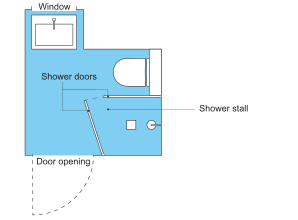
Figure 11. An example of a shower stall positioned relative to doors or windows during renovation of a small wet room. To protect moisture-sensitive materials and constructions in the best possible way, the shower stall or bathtub should be placed well away from these (e.g., well away from windows and doors) (see Figure 10). If this proves impossible (e.g., for renovation projects) moisture-sensitive constructions can be protected by screens or fixed doors as shown in this figure. For renovation projects, it is not always feasible to comply with accessibility requirements. In this example, access to the shower and toilet can be improved using shower doors which will fold back into the stall or by removing the shower door between toilet and shower stall. In this case, the door should be replaced by a shower curtain.
There should be min. one window in the wet room to air the room properly and to allow for daylight penetration.
1.9.4 Choice of Materials and Constructions
Once the load class has been determined, materials and constructions should be selected to comply with the load class and hence the required level of protection. The safest and most robust constructions would be the natural choice for heavy exposure and high-performance requirements. Conversely, requirements for materials and constructions can be slackened if there is only slight exposure or lower quality requirements. If in doubt, higher load classes and/or more robust construction materials should be selected.
In the choice of materials and constructions, consideration must be given to anticipated daily usage and maintenance of the wet room (see Section 1.9.7, Usage and Maintenance).
1.9.5 Special Focus Areas in the Design Phase
Assumptions for a well-functioning wet room include:
- the design should allow for the surrounding constructions such as deck height and construction materials used
- there should be detailed specifications and drawings showing all necessary details such as wall-floor joints, how to construct a plumbing shaft, and door junctions
- there should be references or clearly stated records of solutions specified by manufacturers, common technical knowledge, relevant specifications, and figures
When designing a wet room, an overall financial approach should be adopted that does not solely focus on short-term cost-minimisation. It should also consider future expenses for repair and maintenance. A wet room with high initial costs, long lifespan, and low maintenance costs may prove to be a better investment than one with low initial costs and a short lifespan.
In the choice of materials, consideration should be given to the desired maintenance standards and whether there may be areas with particularly high exposure to water.
Besides requirements directly related to water load, people may have other needs or wishes for their wet room. These may include light-grade construction, avoiding construction-related moisture, or a need for extra protection because the consequences of damage would be significant.
During their work, designers should perform quality assurance for their project. Examples of issues to consider as part of a quality assurance process are shown in Annex A. Checklists for Design and Construction.
1.9.6 Construction
Wet room construction must be carried out with planned solutions. Any ambiguities in the project should be clarified before commencing work. If adjustments have been agreed upon, these should be followed with revised drawings and specifications.
If certain tasks are particularly complex, these should be reviewed and/or supervised by the work supervisor (the first time they are carried out at minimum).
Contractors should subject their own work to quality assurance on an ongoing basis.
Certain tasks are easy to check but difficult to rectify afterwards, including the functioning of heat cables or the thickness of waterproofing membranes. Therefore, checks should be carried out on an ongoing basis while it remains easy to rectify errors. Examples of issues to consider as part of the quality assurance are shown in Annex A. Checklists for Design and Construction. Quality assurance should be documented in writing.
When the job has been completed, drawings and/or specifications should be prepared, showing the actual construction of the wet room (as-built drawings). The drawings and specifications can be used when carrying out maintenance.
1.9.7 Usage and Maintenance
The daily use of wet rooms significantly reduces their lifespan. Correct use and maintenance can reduce the exposure of materials and constructions, resulting in an extended lifespan. Moreover, floors, walls, and installations in wet rooms should be checked regularly as leakages can result in extensive damage to the surrounding building parts. Any leakages should therefore be rectified without delay. Annex B. Daily Use, Maintenance, Inspection, and Repairs outlines the minimum information which should be included in a user manual.