3 Floor Constructions
Floor constructions in wet rooms can be divided into the following four main types:
- Inorganic subfloor on heavy-grade deck constructions such as concrete or lightweight concrete (see Section 3.2.)
- Subfloor of wooden sheets on timber joist constructions (see Section 3.3.)
- In situ concrete on timber joist constructions (normally only for renovation work) (see Section 3.4.)
- Light-grade double construction featuring two watertight layers around an inorganic water-resistant concrete layer (see Section 3.5.)
3.1 Application Areas and Waterproofing Systems
3.1.1 Application Areas
A distinction is made between heavy- and light-grade constructions:
- Heavy-grade constructions comprise decks of inorganic materials such as concrete or lightweight aggregate concrete.
- Light-grade constructions comprise decks of organic materials such as timber joist constructions with subfloors of wooden sheets.
Heavy-grade constructions can, in terms of moisture resistance, be used in all conditions while light-grade constructions can only be used to a limited extent because moisture absorption can lead to serious damage. Any leakages should therefore be detected quickly, so that the extent of secondary damage can be contained. Moisture must not be able to accumulate in constructions containing sensitive materials.
Wood or wooden sheets must not be used as flooring on concrete or lightweight aggregate concrete decks, as the decks can accumulate water from leakages in floors and walls, which may cause the wood to absorb moisture, resulting in decay and dry rot.
In wet rooms on ground floor slabs or above inaccessible rooms (e.g., crawl spaces with less than 0.6 m headroom), decks must be constructed with inorganic materials (see Figure 26). Consequently, wood-based materials must not be used here.
Class H wet rooms are expected to sustain heavier loads than wet rooms in dwellings and decks and floors should therefore be constructed with inorganic materials (see Section 3.2, Heavy-Grade Deck Constructions). Therefore, wood-based materials must not be used in class H wet rooms (such as common shower facilities in schools and sports halls, nor in production halls in the food industry and catering kitchens).
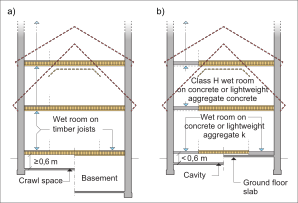
Figure 26. Application areas for wet rooms on timber joist constructions, concrete, and lightweight aggregate concrete.
- Wet rooms only to be constructed on timber joist constructions if the underlying spaces (including basements and crawl spaces) are accessible and have a min. headroom of 0.6 m.
- On ground floor slabs and above accessible spaces (including spaces with a headroom below 0.6 m, such as low crawl spaces) wet rooms must be constructed on concrete or lightweight aggregate concrete decks. Floors must be constructed without wood and wooden sheets. In all cases, Class H wet rooms must always be constructed on concrete or lightweight aggregate concrete decks.
3.1.2 Slopes Towards Floor Gullies
Building Regulations provisions stipulate that water on the floor must flow to a floor gully. Floors must therefore be constructed with slopes towards floor gullies. Slopes are normally approx. 1 %. However, below bathtubs and permanent fixtures it should be at least 2 %.
In large wet rooms, slopes towards gullies can be reduced (e.g., to 0.5 %) in parts of the room not regularly exposed to water (such as the area outside a recessed shower stall or in the areas delimited by dotted lines in Figures 2 to 9). However, the floor must be free from back slopes and depressions (see Section 1.5.2, Humid Zones), because standing water on the floor increases the risk of slope accidents (slippery floor) and water exposure. When constructing floors, there will always be a degree of tolerance in the planeness that can be achieved and to minimise the risk of depressions (ponding) it is inadvisable to construct completely level floors.
For stationary workplaces where employees stand or sit for the majority of the day, slopes should be minimised as much as possible.
For floors cleaned by hosing them down, slopes should be 1 %.
For non-stationary workplaces, slopes of 1 % will normally be acceptable. This would, for example, apply to bathrooms in care homes and similar settings, in which employees only stay for short periods during their working day and adopt many different work postures.
3.1.3 Floor Gullies – Types and Position
Floor gullies must be suited to the specific floor type and flooring. It is advisable to use VA-approved gullies because this is the easiest way to ensure that the national Danish requirements are complied with. Further information on floor gullies is available in Section 8.3, Wastewater Installations.
The gully base should be positioned at least 60 mm from timber joists with the edge of the gully base/grid spaced at least 150 mm from the wall. The distance from the floor gully to the door should be min. 600 mm to obtain suitable slopes. Floor gullies must be accessible for cleaning and must never be positioned where washing machines or tumble driers are likely to be placed. Floor gullies must not be covered by cupboards or similar fixtures, which make them difficult to clean (see DS 432, Wastewater installations) (Danish Standards, 2009b).
If using a channel drain or corner drain, the above requirements can be deviated from. If so, the floor gully must carry an ETA or MK approval and be installed according to manufacturer’s instructions. The ETA or MK approval documents that the gully can be installed watertight in the construction without damaging adjacent building parts.
The gully base must be fixed to the substrate (e.g., embedded in or screwed to the subfloor). The gully connections must be sufficiently flexible to absorb minor vertical movement without displacing the floor gully relative to the floor construction.
3.1.4 Combinations of Floor Construction and Waterproofing Systems
The floor construction determines the type of waterproofing and surface finish that may be used. The range of options regarding waterproofing systems is greater for constructions made of inorganic materials (i.e., constructions considered intrinsically watertight). The combination options are listed in Table 3.
Table 3. Combinations of floor constructions and waterproofing systems. The table states in which load classes a given combination can be used (e.g., concreting on timber joist constructions with a tile setting system without a membrane can be used in load classes L and M). The division into load classes is explained in more detail in Section 1.6, Load Classes. Combinations with green and yellow colour markings can be used, but yellow can be used only in certain conditions.
Waterproofing Floor Construction | MK-Approved Tile Setting Systems with Membranes | Pvc | Roll Material (e.g., roofing membrane as a substrate for tiles) | Tile Setting Systems Without Membranes. Requirements for MK Approval Must be Met and Documented 1) | None (i.e., just a water-repellent tile covering in ordinary tile adhesive or terrazzo) 2) |
|---|---|---|---|---|---|
Concrete cast on site3) |    |    |    |    |    |
Concrete/lightweight concrete slabs4) |    |    |    |    |    |
Concrete/lightweight concrete prefabs5) |    |    |    |    |    |
Concrete on timber joists |    |    |    |    |    |
’Watertight’ sheets on timber joists6) |    |    |    |    |    |
’Double floor’ on timber joists7) |    |    |    |    |    |
Plywood on timber joists |    |    |    |    |    |
Particle board on timber joists |    |    |    |    |    |
- The column applies to tile setting systems without a membrane (see definition of tile setting systems in Section 6.1.).
- The column applies to tile coverings fixed with ordinary tile adhesive, without a waterproofing system. Tiles fixed in ordinary tile adhesive will be less protective against water infiltration than solutions using a water proofing system. These coverings are therefore given a lower classification than similar solutions using a waterproofing system (see the column ’Tile Setting Systems Without a Membrane’). However, tiled floors on decks with a cast kerb or terrazzo can also be used in load class M.
- Both concrete and work procedure as well as concreted recesses (e.g., around floor gullies), must be subject to quality control.
- Joints between units must be watertight. This also applies to wall joints.
- Factory-produced units supplied with ready-made surface covering.
- 'Watertight' should be understood as MK-approved sheets with an intrinsically watertight surface or surface covering such as plastic coating. In addition, a further watertight surface coating must be applied.
- ’Double floor’ should be understood as waterproofing having been carried out twice and that inorganic material has been placed between the waterproofing layers.
If using a combined floor construction and waterproofing system classed lower than the actual wet room class, the overall construction must be regarded as being at ‘greater risk’ (see Bekendtgørelse om kvalitetssikring af byggearbejder i alment byggeri m.v. og ombygninger efter lov om byfornyelse og udvikling af byer (Statutory Order on Quality Assurance of Construction Work in Social Housing, etc., and Conversions Pursuant to the Law on Urban Renewal and Development) (Ministry of Urban Areas, Housing and Rural Districts (now defunct), 2011)). For publicly financed housing, designers are required to prepare a declaration to the building owner to this effect. Should the building owner decide to use the construction proposed, any special measures implied by this choice must be clarified (e.g., more rigorous inspections during construction and increased checks and maintenance).
3.2 Heavy Deck Constructions
3.2.1 Build-Up
Heavy-grade deck constructions mostly consist of concrete poured on site, slab concrete, or lightweight slab concrete. Heavy-grade decks are inorganic and often regarded as intrinsically watertight. In theory, this means that they can be used without further waterproofing.
General Requirements
In practice, concrete layers should be min. 60 mm thick and of quality concrete to be intrinsically watertight. Quality concrete is concrete with a compressive strength of min. 20 MPa. Furthermore, any joints between deck slabs are required to be tight and remain so through time. Joints must not be subject to failure (e.g., through masonry movement). Furthermore, joints between heavy-grade deck constructions and walls must be watertight (e.g., using flashing transitions between floor and walls with a reinforcement strip and a waterproofing membrane) (see Section 3.2.3, Watertightness).
On lightweight aggregate concrete or decks with vulnerable joints, the floor must be given an appropriate watertight covering, such as a watertight tile setting system (i.e., one with a min. 1.0 mm thick waterproofing membrane or PVC flooring). Normally, screed is laid on the deck or an additional concrete slab is placed, possibly on a layer of insulation material for acoustic reasons. Aggregate with the largest possible aggregate size should be used because this will result in minimal settlement. The max. aggregate size can be up to one third of the layer thickness. Slopes can be constructed in the screed or in the actual concrete slab when placed.
Concrete Slabs
When pouring a second concrete slab over the deck, fine aggregate concrete is used for thicknesses ranging from 30 to 70 mm and medium aggregate concrete for thicknesses ranging from 60 to 100 mm. For layer thicknesses above approx. 40 mm, crack control reinforcement consisting of 6 mm steel rods per 100 mm should be used in both directions or a mesh reinforcement equivalent. The reinforcement is continued up wall bases/kerbs, if relevant. The mesh reinforcement must be linked to an equalizing connection (earth connection) (see Section 6 in the Stærkstrømsbekendtgørelsen (Statutory Order on High-Voltage Power) (Ministry of Business Affairs, 2001). Furthermore, the statutory order stipulates a mesh width of max. 100 mm for the mesh reinforcement as described above.
The concrete compressive strength must be min. 20 MPa (concrete C20/25 according to. DS/EN 206-1). If the concrete slab is poured on site, it is advisable to construct a min. 100 mm kerb as a base under the walls. In this way, the most vulnerable joint is elevated, thereby reducing water exposure as far as possible.
If the thickness of the concrete slab is less than 60 mm, it can be poured directly on the substrate (deck) provided there is adequate adherence. For thicknesses above approx. 60 mm, the concrete is poured on a separating film (e.g., two layers of 0.15 mm PE foil or on a layer of insulation material) which will help to reduce impact sound.
Screed
Screed is usually made of well-graded cement mortar C 100/400 (concrete wear layer) 15 to 30 mm thick or of 0–4 mm fibrous concrete up to 40 mm thick. Before applying the screed, good adherence must be ensured using concrete adhesive or by washing the surface area with cement grout C 100/100.
3.2.2 Curing Shrinkage
Concrete and screed will shrink while curing, which may result in tension between tiles and substrate. The shrinkage is relative to the concrete composition, thickness, temperature, and moisture conditions. Shrinkage will be most marked at the start and will then subside. Tiling should therefore be executed late in the construction process when most of the shrinkage have occurred.
In practice, shrinkage of cement types with normal curing times at a temperature of approx. 20 °C can be expected end after 4–8 weeks, depending on concrete composition, air humidity, whether it dries out in one or two sides, and other factors. The time between casting the concrete and tiling could be reduced by using cement types with a faster curing time, such as those with limestone filler. Special concretes exist which will cure and shrink in a few days (e.g., calcium aluminate cement (CAC) concretes).
Good curing conditions can be achieved by covering the concrete with tight-fitting plastic foil immediately after casting and keeping it covered for at least 3 days.
3.2.3 Watertightness
A concrete slab is considered intrinsically watertight if built as specified above. One could also carry out further sealing around the shower stall, bathtub, and floor gully to increase the likelihood of watertightness. This could be achieved by applying a liquid waterproofing membrane, for example.
The joints between floor and walls must always be sealed with flashing (such as a reinforcement strip and a liquid applied waterproofing membrane). The flashing should be continued at least 100 mm out across the floor and at least 100 mm up the walls (see Figure 13 in Section 2.2.3, Joints Between Floors and Walls). If the walls have been waterproofed with a waterproofing membrane, the flashing can be installed by continuing the membrane all the way down and 100 mm out across the floor. If there are membranes in both the floor and walls, the two membranes must be joined in a watertight seal and be compatible chemically and over time.
3.2.4 Floor Gullies
Floor gullies for concreting in should be VA-approved for concrete embedment. If possible, gullies with vertical discharge spouts should be used, as pipes in storey partitions should be avoided both to achieve adequate slopes for discharge pipes and to avoid weakening the storey partition.
Floor gullies should be embedded such that they are surrounded by min. 60 mm concrete on all sides and normally min. 120 mm upwards.
If a water proofing membrane is to be fitted to the concrete, the floor gully should be VA-approved for embedment into concrete with a watertight layer (see Figure 51 in Section 3.4.2, Bearing Strength of the Construction). In this case, the flange should be min. 40 mm wide to ensure a sealed joint between the floor gully and membrane.
3.2.5 Floor Coverings
Floor coverings on heavy-grade decks include tiles, terrazzo, PVC, or similar coverings.
Floor tiles should be min. 5 mm thick (except for mosaic tiles). The water absorption of tiles should be max. 10 % (see DS/EN ISO 10545-3:1997, Ceramic tiles. Part 3: Determination of water absorption, apparent porosity, apparent relative density and bulk density) (Danish Standards, 1997).
Tiles for floors with underfloor heating should be overfired and should have a water absorption rate of max. 6 %.
For ordinary floor gullies, tiles should be max. 200 × 200 mm, which will facilitate the incorporation of slopes. Otherwise the tiles must be cut along the slope lines in so-called tapered slopes. Using large tiles increases the risk of more unevenness between individual tiles, especially where they cross slope lines (see Section 6.2, Watertight Tile Setting and Wall Covering Systems).
3.3 Floors with Sheet Subfloors on Timber Joists
3.3.1 Build-Up
In wet rooms, light-grade deck constructions on timber joists can be built with a sheeting subfloor. This requires underlying rooms to be accessible and have a min. 0.6 m headroom (see Figure 26 in Section 3.1.1, Application Areas).
Design
Light-grade constructions should be designed so that harmful deformations are avoided, as deformations can harm rigid floor coverings such as tiles. Since light-grade deck constructions on timber joist constructions are moisture-sensitive, they will have to be protected effectively against moisture with watertight flooring, such as:
- A watertight tile setting system consisting of a watertight layer (e.g., a liquid waterproofing membrane) on which tiles are laid. The watertight layer is necessary because tiled flooring is not intrinsically watertight.
- Watertight resilient floor coverings (such as PVC).
Floors with wood-based sheeting subfloors in periodically heated buildings (e.g., holiday homes), should be built with sheeting selected according to TRÆ 60, Træplader (Wooden Sheets) (Adelhøj, Munch-Andersen & Lund Johansen, 2012).
Only One Watertight Layer
Despite constructing the floor plus subfloor correctly with a watertight layer or covering, there will always be a risk of it leaking. To prevent damage to the joist construction and subfloor from decay and dry rot, there should normally be only one watertight layer placed on top of the subfloor. This will prevent water from accumulating in the construction. Any leakages will quickly show on the underside of the joists and repairs can be carried out.
Two Watertight Layers
However, two watertight layers in a construction can be used if there is certainty that no moisture will accumulate between them. For example, a watertight floor covering can be laid directly on top of watertight sheeting or a waterproofing membrane (e.g., PVC flooring on a stainless steel membrane) which, in turn, is laid on sheets of particle board. Similarly, a double construction as shown in Figures 52 and 53 in Section 3.5, Light-Grade Double Floors can be used on condition that the materials between the two watertight layers will tolerate permanent moisture
3.3.2 Timber Joist Constructions and Subfloors
Strength and Rigidity of Timber Joists
Timber joist constructions in wet rooms are subject to the same requirements for strength and rigidity which apply to residential accommodation. If rigid floor coverings such as tiles are used, it is a requirement that joist and batten spacing is reduced to achieve sufficient rigidity. Therefore, the spacing of joists and battens stated in Table 4 should not be exceeded. If bathrooms are built in existing houses, the old floorboards must be removed to inspect the joist construction and assess whether to reinforce the construction, insert trimmer joists, or to make other interventions.
Sheets for Subfloors
Wooden sheets used for subfloors in wet rooms must be CE marked construction-grade sheets of either plywood or particle board according to EN 13986. At minimum, plywood sheets should be
EN 636-S2 quality marked Flooring and particle board sheets should be at minimum EN 312-P5 or P7 quality marked Flooring (see TRÆ 60, Træplader (Wooden sheets) (Adelhøj, Munch- Andersen & Lund Johansen, 2012)).58
Plywood or particle board sheets are laid either on top of joists or on traverses between existing joists. When sheets are laid directly on joists spaced more than 600 mm apart, they must be thicker than stated in Table 4 (see e.g., TRÆ 60, Træplader (Wooden Sheets) (Adelhøj, Munch-Andersen & Lund Johansen, 2012)).
Subfloors for tile coverings or other rigid materials must be plywood, which experiences less moisture-induced movement than particle board. This will reduce the risk of cracks in rigid floor coverings.
Watertight Sheets
A watertight sheet is the term used for sheets whose make-up may be different, but which share the feature that they (inclusive of joints, etc.) are intrinsically watertight. This type of sheet must be accompanied by an MK approval stating the conditions for use. Watertight sheets are protected by a watertight tile setting system or a PVC covering in the same way as other sheets. At the present time, only polystyrene-based sheets carry an approval. They all require a supporting substrate, such as plywood, and a fully covering waterproofing membrane. This type of sheet should only be used in a single layer and in small thicknesses (e.g., 12 mm) to avoid deformation and hence the risk of tiles loosening. Moreover, to spread loads, tiles smaller than 100 × 100 mm should not be used.
Table 4. Wet room floors with wood sheet subfloors on timber joist construction. Sheets incl. thickness and bearing length, support and screw-fix spacing for resilient and rigid flooring (see Figure 27).
Flooring | PVC Roll Material or Other Resilient Flooring | Tiles or Other Rigid Flooring | ||||
|---|---|---|---|---|---|---|
Sheeting CE marked according to. DS/EN 13986 (Danish Standards, 2004) | Particle board DS/EN 312 – Part 6 or 7 (Danish Standards, 2010) | Plywood DS/EN 636 – Part 1, 2, or 3 (Danish Standards, 2012) | Plywood DS/EN 636 – Part 1, 2, or 3 (Danish Standards, 2012) | |||
Thickness of sheet max. joist and batten spacing [mm] | ≥ 22 mm 600 | ≥16 mm1) 300 | ≥ 18 mm 600 | ≥ 15 mm 1) 400 | ≥ 18 mm 300 | ≥15 mm 1) 200 |
Max. screw-fix spacing for sheets, mm
| 150 300 | 150 200 | 150 300 | 150 300 | 150 300 | 150 300 |
Screw type | 4.5 × 60 | 4.0 × 45 | 4.5 × 45 | 4.0 × 40 | 4.5 × 45 | 4.0 × 40 |
- Only use 16 mm particle board and 15 mm plywood when chocking up floors to form slopes.
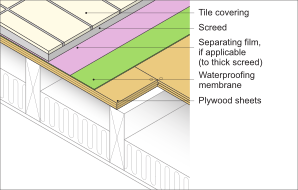
Figure 27. An example of watertight flooring with a subfloor of wooden sheets on new timber joists spaced max. 0.3 m. The subfloor is made of 18 mm structural plywood. The sheets are bonded and screw-fixed to the joists with unsupported bonded tongue-and-groove joints. The plywood is covered by a waterproofing membrane (e.g., from an MK-approved tile setting system). The floor tiles are bonded on a thin screed bed. Thick screed (≥ 60 mm) is applied to a separating film (e.g., two layers of PE foil on top of the waterproofing membrane). The slopes are incorporated into the screed bed.
Floor |    |
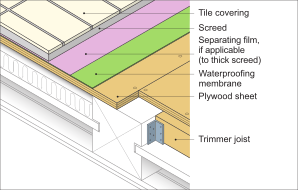
Figure 28. An example of watertight flooring with wood-sheet subfloor on old timber joists spaced max. 1.0 m. The timber flooring has been removed and the pugging has been replaced by mineral wool, perhaps supplemented by plasterboard for acoustic reasons. Headers are placed between the joists with a mutual spacing of 0.3 m. The headers are fixed to the joists with gusset plates. The subfloor is 18 mm structural plywood. Sheets are bonded and screw-fixed to the joists (unsupported cross-beam joints in bonded tongue-and-groove). The plywood is covered by a waterproofing membrane (e.g., from an MK-approved tile setting system). The tile covering is bonded on a thin screed bed. Thick screed (≥ 60 mm) is laid on a separating layer (e.g., two layers of PE foil on top of the waterproofing membrane). Slopes are incorporated into the screed bed.
Floor |    |
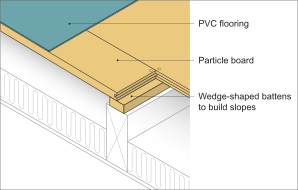
Figure 29. An example of watertight flooring with particle board subfloor on new timber joist construction spaced max. 0.6 m from one another. The subfloor is 22 mm floor particle board, bonded and screw-fixed onto battens. Unsupported cross-beam joints are in bonded tongue-and-groove joints. Battens are wedge-shaped to achieve slopes. Battens are bonded and screw-fixed to the joists. The flooring is watertight PVC bonded to the particle board sheets.
Floor |    |
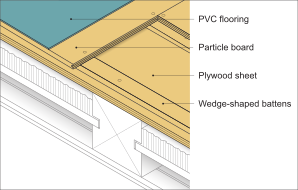
Figure 30. An example of watertight flooring with a wood-sheet subfloor on old joists spaced max. 1.0 m from one another. The timber floor has been removed and replaced by 25 mm structural plywood or perhaps thinner plywood if supporting structures or traverses/trimmers are added to the joist construction. Battens are laid on the plywood spaced max. 0.3 m from one another. The battens are wedge-shaped to achieve slopes and they are bonded and screw-fixed to the plywood. 16 mm flooring particle board is bonded and screw-fixed to the battens and bonded in unsupported tongue-and-groove joints. The flooring is PVC roll material.
Floor |    |
Constructing the Subfloor
Subfloors are constructed when the building has been closed and the heating switched on. Moisture content in joists and wooden sheets must at maximum average 13 % and no measured single value must exceed 15 %. The upper side of the joists may have to be levelled off to achieve a plane substrate.
This can be achieved by firring the sides of joist with min. 45 mm thick planks.
Sheet joints perpendicular to joists or battens can be unsupported while other joints will need supporting. All unsupported joints must be bonded tongue-and-groove joints or must be executed with bonded fillets (i.e., a slip feather used where sheets are grooved on all sides). All free edges along the walls must be supported.
The sheets are bonded to joists or battens and additionally fixed using self-tapping screws with dimensions and spacing as specified in Table 4.
A class D3 moisture resistant adhesive should be used in accordance with DS/EN 204 and DS/EN 205 (Danish Standards, 2001; 2003). Screws must be partially threaded (i.e., the part of the screw penetrating the secured sheet must be unthreaded). Screws must be recessed 1–2 mm. For a PVC floor covering, the screw recesses should not be filled out, as this may be visible in the covering if the sheets should shrink. Examples of floor constructions are shown in Figures 27–30.
Variations in air humidity can cause the sheets to expand, so there must be clearance to walls and pipe penetrations. The required clearance is 1 mm for plywood and 2 mm for particle board per metre of floor width and length. The spacing should be max. 5 mm (see Figure 31).
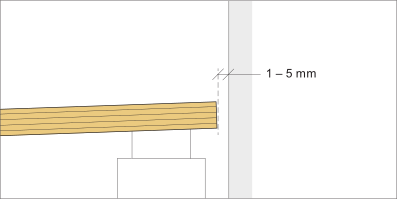
Figure 31. Clearance to walls. Due to moisture-induced movement, wood-sheet subfloors should have a clearance to walls of 1-5 mm.
3.3.3 Constructing Slopes
Subfloor slopes can be constructed in various ways depending on the conditions and especially on the type of waterproofing membrane used. One of the following constructions should be used:
- Slopes constructed with plywood or particle-board sheets divided into triangular pieces (see Figure 32).
- Slopes constructed with plywood or particle-board sheets pressed against wedge-shaped battens (see Figure 33).
- Slopes constructed in the screed bed on top of a waterproofing membrane (see Figure 27).
The latter two methods are frequently used underneath watertight tile setting systems with ETA or MK approvals and PVC floor coverings. Note that MK-approved tile setting systems usually only apply to waterproofing membranes applied directly to the plywood. It is only permitted therefore, to build up slopes with screed prior to applying the waterproofing membrane if this method is documented and is an integral part of the approval.
Method A: Constructing Slopes with Sheets Divided into Triangular Pieces
In this method wedge-shaped battens are laid from each corner in the direction of (and with slopes draining towards) the floor gully. Insert battens or cross-battens as intermediate support. Their height must be adapted to their position and their upper sides should possibly be chamfered. Max. spacing for supporting structures/battens is listed in Table 4. Supplement wedge-shaped battens with edge battens along all delimiting walls. All battens must be supported on a substrate of joists, traverses, or trimmers (see Figure 32). Fix battens to joists, traverses, or trimmers with adhesive and screws. The floor surface consists of min. 15 mm thick plywood or min. 16 mm thick particle board divided into triangular pieces corresponding to the triangles formed by the battens from the corners to the gully. Bond and screw-fix sheets to all battens.
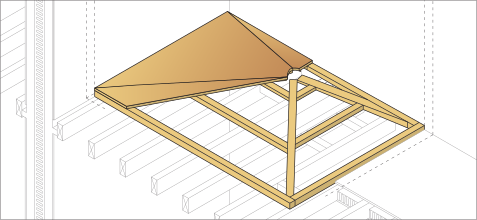
Figure 32. New joist construction with joists spaced out approx. 0.4 m. The flooring has so-called tapered slopes where the floor is divided into five triangular planes, each with slopes towards the floor gully. The battens going towards the floor gully are wedge-shaped and the height of the interposed cross-battens is adapted accordingly. The edge batten by the floor gully is split where it is level with the gully. Each batten half is wedge-shaped with chamfered upper sides. The battens are spaced out max. 0.6 m from one another. Headers have been fitted between the joists under battens inadequately supported by joists. Edge batten can be staggered, thus doubling as wall plates in partition walls. Battens are fixed to joists, trimmers, or headers with adhesive and screws. The subfloor is made of 22 mm particle board in preparation for PVC floor covering (see Table 4). The particle board sheets are bonded tongue-and-groove in all unsupported joints and bonded and screw-fixed to the battens.
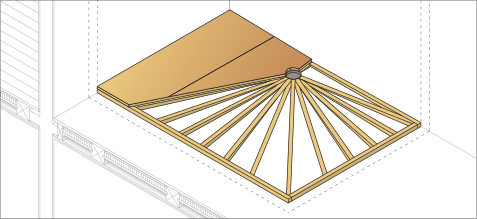
Figure 33. Old joist construction with joists spaced out approx. 1.0 m on top of which 25 mm plywood is laid. The plywood can be thinner if supporting structures or trimmers are fitted to the joists. A substrate of wedge-shaped battens is placed on top of the plywood in the direction of the floor gully and spaced out max. 0.40 m for plywood and 0.30 m for particle board. Edge battens have been laid along all edges. The edge batten behind the floor gully is wedge-shaped and has a chamfered upper side. The subfloor is made of 15 mm structural plywood or 16 mm floor particle board, forming a plane in the shape of a flat cone. The sheets are bonded tongue-and-groove in all unsupported joints. The sheets are pressed down and bonded and screw-fixed to the battens.
Method B: Constructing Slopes with Sheets Pressed Against Wedge-Shaped Battens
The slope is constructed over a level substrate (e.g., made of structural plywood). If the space between joists is big or the plywood thin, trimmers should be added to the joists, so that the substrate becomes as rigid as an ordinary timber floor (see TRÆ 64, Trægulve – lægning (Timber Floors – Laying)) (Brandt, Slott & Lund Johansen, 2010). Place the wedge-shaped battens on the substrate in the direction of (and with slopes towards) the floor gully (see Figure 33). Supplement the wedge-shaped battens with edge battens along all delimiting walls. The max. spacing between supporting structures/battens is listed in Table 4. All battens must be supported on the horizontal substrate or directly on joists, trimmers, or headers (see Figure 33).
Construct the floor of min. 15 mm plywood or min. 16 mm particle board bonded and screw-fixed to the wedge-shaped battens.
Method C: Constructing Slopes in Screed Bed on Top of a Waterproofing Membrane
The screed bed must be made of moisture-resistant material. The thickness depends on the product selected and should normally be applied in relatively thin layers (see Figure 27). Traditional cement-based screeds will normally be min. 30 mm while specialised compounds can be just a few mm.
If the screed bed is thicker than approx. 60 mm, a separating film (e.g., two layers of polyethylene foil min. 0.15 mm thick) can be laid across the watertight layer on the subfloor. If underfloor heating is incorporated into the wood-sheet floor construction, a solution including separating film should be considered, so that moisture-induced movement in the sheets will not be transmitted directly to the tile layer. A proper concrete slab should therefore be considered (see Section 3.4, In-Situ Floors Concrete Timber Joists). Thick screed should be reinforced with thin mesh reinforcement linked to an equalising connection (earth connection).
The screed bed should be sufficiently hardened and dry before tiling, as shrinkage during subsequent curing and drying might cause the tiles to loosen or crack. Curing shrinkage is discussed in Section 3.2.2. Curing Shrinkage.
Floors with slopes constructed on existing timber joists will normally be higher than floors in adjacent rooms. This is because floors are usually constructed on top of the joists. Cutting joists is only permitted in order to achieve slopes in the floor, provided that it can be proved by calculations that joist dimensions will support this. If two opposite walls below the wet room walls are stress-bearing, the level difference can be avoided by installing new joists with joists placed lower and closer together in the wet room than in the remaining rooms (see Figure 34).
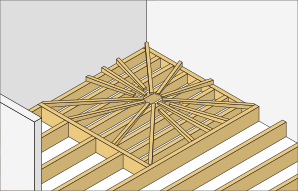
Figure 34. Floor with slopes at the same level as floors in the remaining rooms.
3.3.4 Floor Coverings
Floor coverings can be tiles or PVC.
Tiles – Rigid Floor Coverings
Tiles are only to be used on plywood subfloors or floors made of wood-based sheets carrying an ETA or MK approval. Even though a floor construction is built with wood-based sheets carrying an approval, they can only be used in load class M (medium), as is the case with other wood-based sheet flooring.
Tile coverings are not watertight and can only be used if the subfloor is protected with a suitable watertight layer (see Figure 75 in Section 6.1, Watertight Tile Setting and Wall Covering Systems). The following can be used as watertight substrates for tiles on plywood subfloors:
- Waterproofing membrane (min. 1.0 mm thick as part of a tile setting system carrying an ETA or MK approval for use as floor covering in wet rooms) (see Section 6.1, Watertight Tile Setting and Wall Covering Systems).
- PVC roll material (meeting the requirements in Section 6.2.1, Assumptions for Using PVC)
- Roofing underlay of EPDM, butyl, or PVC (with a min. thickness of 1.0 mm, a min. rupture strain of 200 %, and a tensile strength of min. 8 N/mm2)
- Prefabricated waterproofing membranes (as part of a tile setting system carrying an ETA or MK approval for use as floor coverings in wet rooms)
The watertight layer is laid across the plywood subfloor and continued
up and fixed to the walls at min. 100 mm above the finished floor level. It is joined in a watertight joint or overlapped with a watertight wall covering or paint application (see Section 2.2.2, Watertightness).
Waterproofing membranes must be installed according to manufacturer’s instructions. Depending on the type, liquid membranes can be applied with a brush, paint roller, or a notched trowel.
Roofing underlay and PVC used as substrates for tile coverings must be sufficiently robust to withstand impact from foot traffic and subsequent work. Large-width roll material is used to obtain as few joints as possible in the watertight layer.
So-called flexible tile adhesive is used to fix tiles while allowing small dimensional changes to be absorbed. If a watertight ETA or MK approved tile setting system is used, the tiles can be bonded directly to the watertight substrate as described in manufacturer’s instructions.
PVC – Resilient Floor Coverings
Subfloors for PVC can be made of plywood as well as particle board.
PVC floor coverings are resilient and do not place strict requirements on subfloor rigidity. The slopes of the finished PVC floor are identical to slopes on the substrate. Therefore, there must be no depressions in the subfloor between supporting structures. A watertight layer of PVC floor covering is required to meet the quality and workmanship requirements mentioned in Section 6.3, PVC Floor- and Wall Coverings.
3.3.5 Floor Gullies and Plumbing Installations
Plumbing must be carried out in accordance with the guidelines in Section 8, Plumbing Installations. Discharge pipes from floor gullies and other installations should not normally run within the joist construction but below it. They may run above suspended ceilings which must be demountable or have hatches for inspection and repair.
To ensure sufficient space for pipe penetrations, the clearance between pipes should be min. 60 mm and between pipes and walls should be min. 30 mm (see Figure 110 in Section 8.3, Wastewater Installations). For renovation work, complying with these measurements may mean that pipes will have to be moved, potentially to a pipe shaft with a hatch providing access for inspection, repair, or replacement.
Figures 35 and 36 show examples of floor gullies mounted in tiled floors on a watertight substrate on a wood-sheet subfloor. Floor gullies must be fitted with flanges screw-fixed to the subfloor and possibly counterbored until the flange is flush with the subfloor surface. The floor’s watertight layer is linked in a watertight joint to the flange. This should be min. 40 mm wide to ensure tightness. The seam between tile covering and floor gully is sealed with sealant.
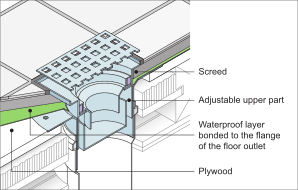
Figure 35. A floor gully with tiles bonded to a screed bed. The subfloor is made of 18 mm plywood laid on an old timber joist construction (not shown). The floor’s watertight substrate/waterproofing membrane is bonded to the flange of the floor gully. Prior to bonding, the gully flange should be degreased and possibly primed. Alternatively, a floor gully can be used whose watertight layer (e.g., a collar), is bonded into the gully and clamped as shown in Figure 36. A floor gully has been selected whose upper part can be extended vertically according to the thickness of the screed.
Floor |    |
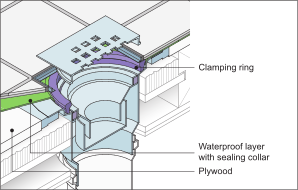
Figure 36. An example of a floor gully with an approved tile setting system. The subfloor is made of 18 mm plywood laid to slope towards the floor gully on a new timber joist construction (not shown). A sealing collar is fitted around the gully (part of the waterproofing system). The collar is bonded to the 40 mm wide flange on the floor gully and further secured in the gully with a clamping ring. The waterproofing membrane is applied to the whole collar as well as to the rest of the floor. The tiles are bonded directly to the waterproofing membrane as specified in the instructions applicable to the approved tile setting system in question.
Floor |    |
Examples of floor gullies for floors with PVC coverings on wood-sheet subfloors are shown in Figures 37 and 38. Waste gullies must have flanges recessed until flush with the subfloor surface. The floor gully must be screw-fixed to the subfloor. After being heated, the floor covering is continued down into the gully and sealed to this by bonding the covering to the flange and securing it with a clamping ring in the gully.
The clamping ring can either be conical or flexible. If flexible, it must be adapted to the thickness of the floor covering.
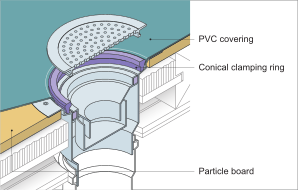
Figure 37. A gully with a clamping ring in the floor with a PVC covering. The subfloor is made of 16 mm particle board on wedge-shaped battens (not shown). The floor covering is continued into the gully and secured by a clamping ring.
Floor |    |
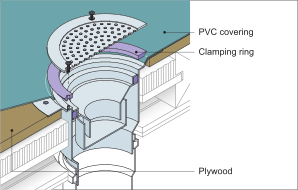
Figure 38. A gully with a clamping ring in the floor with a PVC covering. The subfloor is made of 16 mm particle board on wedge-shaped battens (not shown). The floor covering is continued into the gully and secured by a clamping ring.
Floor |    |
3.4 In-Situ Concrete Floors on Timber Joist Constructions
3.4.1 Application Area and Assessment of Existing Construction
In situ concrete on timber joist constructions can be used for new timber joists and joists in old properties. These can be considered intrinsically watertight if constructed as described in this section. However, supplementary waterproofing is recommended (e.g., by installing a waterproofing membrane in areas with the highest water exposure like in shower stalls). In Medium load classes, floor waterproofing membranes must be installed.
Wet rooms built on in situ concrete and timber joists is not permitted on timber joists above ground floor slabs and above inaccessible spaces (e.g., low-ceilinged crawl spaces below 0.6 m, or high-load wet rooms) (see Figure 26, Section 3.1.1, Application Areas).
3.4.2 Bearing Strength of the Construction
For in situ concrete on timber joists, the bearing strength of the timber joists and the concrete must be documented. This is documented according to DS/EN 1992-1-1 + AC:2008 Eurocode 2: Design of concrete structures – Part 1-1: General rules and rules for buildings (Danish Standards, 2008), and DS/EN 1995-1-1 + AC:2007, Eurocode 5: Design of timber structures - Part 1-1: General - Common rules and rules for buildings (Danish Standards, 2007a).
For existing timber joist constructions, documentation must be based on an inspection. Floorboards must be removed prior to the inspection. Documentation of the bearing strength is based on one or more of the following:
- visual inspection of the condition of the timber joist construction, assessing whether it is in reasonable condition (i.e., without major shrinkage gaps and deformation and without any sign of failure of wooden parts or joining mechanisms)
- registering the design and mode of operation of the timber joist construction, assessing whether this complies with rules and practice at the time of installation
- calculating the bearing strength of the timber joist construction according to present-day construction norms
When registering the design, the following is checked:
- dimensions and spacing of timber joists
- quality of timber joists and construction (e.g., whether there is an inordinate number of wanes) (max. 1/3 of the length of the edge), weaknesses near grooves, or insufficient wall supporting structures
- construction changes after initial construction which might affect bearing strength
At registration, an assessment should be made as to whether the operation and rigidity live up to expectations. The condition of the joist construction should be documented (e.g., with photos).
On inspection, where old timber joist constructions in multistorey buildings from the period around 1850–1940 where no deviations from the expectations are discovered, concrete can be cast in situ without calculated documentation of bearing strength and rigidity of joists. This assumes that the assembly is designed as a normal joist construction (cf. SBi-report 142, Multistorey dwellings in Copenhagen 1850–1900) (Engelmark, 1983) (i.e., with a centre-to-centre joist spacing of max. 900 mm or timber joists with a similar bearing strength). Furthermore, it is assumed that the max. free span complies with that stated in Table 5, since:
- timber joists must be without significant wanes or other irregularities which might reduce bearing strength or rigidity
- the timber joists must have min. 100 mm support on the brickwork
- pugging must be completely removed when renovating and must be replaced by light insulation material
- the average thickness of the concrete layer must be max. 80 mm
Table 5. Max. free span of timber joists for in situ concrete relative to joist dimension.
Joist dimension [mm] | 150 × 150 | 163 × 163 | 175 × 175 | 188 × 188 | 200 × 200 |
|---|---|---|---|---|---|
Max. free span [m] | 3.0 | 3.4 | 3.8 | 4.2 | 4.6 |
For the max. spans stated, the wet room can occupy the entire span of the timber joists. If the wet room does not extend across the full span of the timber joists, the max. span can be increased based on the calculation of strength and rigidity.
If joists are estimated to be too weak to support the increased load from the planned in situ concrete and watertight floor, their strength and rigidity must be calculated and the joists reinforced to the extent necessary (cf. SBi Guidelines 251, Vurdering af eksisterende konstruktioners bæreevne (Assessing the Bearing Strength of Existing Structures)) (Pedersen, 2015). It will often be necessary to insert trimmers and/or headers to ensure stable support for both concrete slab and new walls, if applicable.
Woodwork decayed by fungus or dry rot must be removed and replaced; alternatively, the joists must be replaced.
3.4.3 Build-Up
Substrate and Level Differences
The following can be used as substrate for in situ concrete:
- Pressure-proof mineral wool laid on existing pugging boards (see Figure 41)
- Plywood placed between joists on battens screw-fixed to the sides of joists (see Figure 42)
- Plywood placed continuously on top of joists (see Figure 43)
- Corrugated steel sheet with an ETA or MK approval documenting that they are suitable for the purpose. The corrugated steel sheets are laid continuously on top of joists (see Figure 44)
The level difference between the floors inside and outside the wet room will be as small as possible when the substrate for concreting is level with the upper side of the joists. This is an advantage in terms of access for walking-impaired persons, as the doorstep into the wet room will be as low as possible.
Another possibility to reduce doorstep height is using special concretes carrying ETA or MK approval. These concretes can be poured in thinner layers across the joists than ordinary concrete. The currently applicable approvals allow a layer thickness of approx. 45 mm. The construction must be waterproofed with a waterproofing membrane on top of the concrete.
Placing the Concrete Floor
Concreting water and sludge must be prevented from infiltrating pugging and ceiling plaster (e.g., by mounting geotextile fabric on the concrete substrate). The geotextile fabric must be permeable (i.e., not watertight), preventing water from leakages from accumulating in the construction, but allowing it to quickly penetrate to the underside of the joists and become visible. Repairs can then be initiated quickly, if required.
The concrete is cast in accordance with the guidelines described in Section 3.2 Heavy-Grade Deck Constructions.
Use concrete with a strength of min. 20 MPa (C20/25 concrete according to DS 2426 – EN 206-1) (Danish Standards, 2011). The thickness of the concrete must be min. 60 mm. The concrete must be reinforced against cracks with 6 mm rod steel per 100 mm in both directions, or corresponding mesh reinforcement placed at the centre of the concrete layer. The reinforcement is continued up wall bases, if applicable, and must be linked to an equalisation connection (earth connection) in accordance with Stærkstrømsbekendtgørelsen (Statutory Order on High-Voltage Power) (Ministry of Business Affairs, 2001). Allowances must be made for shrinkage as discussed in Section 3.2.2, Curing Shrinkage.
Flooring
Tile or PVC flooring on concrete is fitted as described in Sections 6.2, Watertight Tile Setting and Wall Covering Systems and 6.3, PVC Floor and Wall Coverings.
Supporting Structures for Walls
New walls on old timber joist constructions must be supported by joists or traverses/trimmer joists placed transversely between the joists. If a wall is placed longitudinally between joists, it must be supported by headers or a baseboard over the traverses/trimmer joists.
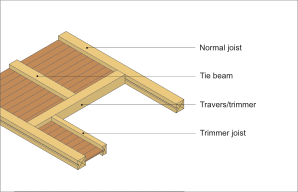
Figure 39. Traverses/trimmers and trimmer joist in old timber joist construction to make supporting structures for floor slabs or new walls.
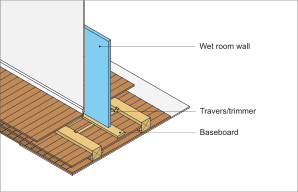
Figure 40. Example of new wall support with a baseboard over trimmer joists.
To counteract cracks between floors and new walls, it is advisable to cast bases with a height of min. 100 mm above the finished floor. Under doors, however, this can be reduced to max 20 mm above the finished floor. This is done at the same time as casting the concrete deck, thereby ensuring continuity and tightness in the corners. Shrinkage reinforcement must be continued up into the base. This ensures that the critical joint is shifted to the wall where the water load is less intense.
Walls must be anchored to bases (e.g., with embedded bolts). When the concrete adjoins existing brick walls, the concrete slab can be anchored to the wall with bolts fixed to the wall and embedded in the concrete.
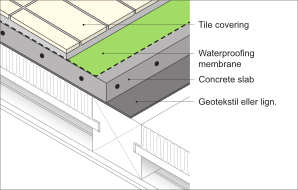
Figure 41. An example of in situ concrete on old timber joist construction. The timber flooring has been removed and the pugging replaced by pressure-proof insulation, potentially supplemented by plasterboard to improve acoustic and fire insulation. The insulation is placed so that the upper side is level with the upper side of the joists. A vapour-permeable concreting substrate has been placed over the insulation to prevent mixing-water from infiltrating the underlying layers.
Floor |    |
This solution is applicable for load class M if a waterproofing membrane has been fitted across the concrete.
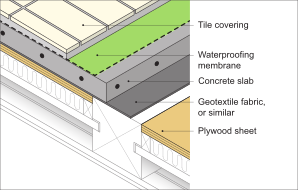
Figure 42. An example of in situ concrete on old timber joist construction. The timber flooring has been removed and the pugging replaced by insulation. This is potentially supplemented by plasterboard to improve acoustic and fire insulation. 22 mm plywood has been placed between the joists on battens nailed to the sides of the joists. A vapour-permeable concreting substrate has been placed over the plywood and joists to prevent mixing-water from infiltrating the underlying layers.
Floor |    |
This solution is applicable for load class M if a waterproofing membrane has been fitted across the concrete.
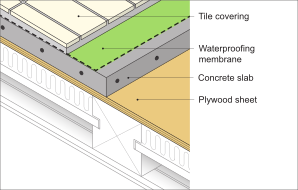
Figure 43. An example of in situ concrete on old timber joist construction. The timber flooring has been removed and the pugging replaced by insulation. This is potentially supplemented by plasterboard (not shown) to improve acoustic and fire insulation. 22 mm plywood has been nailed to the joists. Vapour permeable geotextile fabric (not shown) has been placed over the joints between floor and walls to prevent mixing-water from infiltrating the underlying layers.
Floor |    |
This solution is applicable for load class M if a waterproofing membrane has been fitted across the concrete.
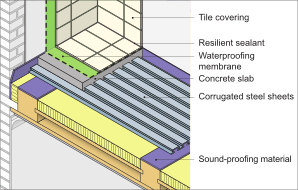
Figure 44. An example of in situ concrete on old timber joist construction. The timber flooring has been removed and the pugging replaced by insulation. This is potentially supplemented by plasterboard (not shown) to improve acoustic and fire insulation. The concrete slab is a floating construction to enhance the acoustic insulation. In this example, the floating construction has been made by fitting an impact-sound-reducing substrate before the concreting substrate (in this example, corrugated steel sheets).
Floor |    |
This solution is applicable for load class M if a waterproofing membrane has been fitted across the concrete.
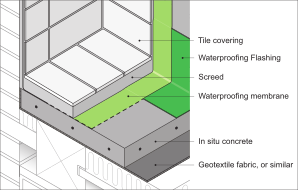
Figure 45. An example of watertight flashing of a joint between in situ concrete and wall. The flashing consists of a reinforcement strip and the subsequent application of a waterproofing membrane. The flashing must be continued min. 100 mm across the floor area and min. 100 mm up the wall above the finished floor. In this example, the floor tiles are bonded to screed bed on the concrete. The wall tiles are bonded to existing wall rendering. Using waterproofing membranes on both the floor and walls is recommended (shown in green colour and as a dotted line). To reduce the risk of cracks forming between floor and walls, the concrete can be anchored to the walls with embedded bolts. The concreting substrate is shown as pressure-proof mineral wool on pugging boards. The application area for tile coverings on inorganic walls depends on the tile setting system (see Tables 6 and 7 in Section 4.1.2, Combinations of Wall Constructions and Waterproofing Systems).
Floor |    |
This solution is applicable for load class M if a waterproofing membrane has been fitted across the concrete.
Wall in wet zone |    |
Wall in humid zone |    |
This wall solution is applicable for load class H if a waterproofing membrane has been fitted to the wall.
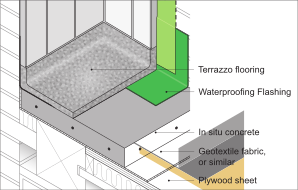
Figure 46. An example of the watertight flashing of a joint between concrete slab and wall. Using waterproofing membranes on the walls is recommended (shown in green colour and as a dotted line). Terrazzo flooring has been installed on the concrete slab with a base and concave moulding. No membrane has been used under the terrazzo flooring, as this can damage the bonding between concrete and terrazzo. To reduce the risk of cracks forming between floor and walls, the concrete can be anchored to existing walls with embedded bolts. The concreting substrate is shown as 22 mm plywood installed between the joists. The application area for tile coverings on inorganic walls depends on the tile setting system (see Tables 6 and 7 in Section 4.1.2, Combinations of Wall Constructions and Waterproofing Systems).
Floor |    |
Wall in wet zone |    |
Wall in humid zone |    |
This wall solution is applicable for load class H if a waterproofing membrane has been fitted to the wall.
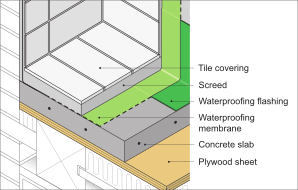
Figure 47. An example of watertight flashing, floor, and wall covering. Using waterproofing membranes on the walls is recommended on both floor and walls (shown in green colour and as a dotted line). The concreting substrate is shown as 22 mm plywood installed on top of joists. The application area for tile coverings on inorganic walls depends on the tile setting system (see Tables 6 and 7 in Section 4.1.2, Combinations of Wall Constructions and Waterproofing Systems).
Floor |    |
This solution is applicable for load class M if a waterproofing membrane has been fitted across the concrete.
Wall in wet zone |    |
Wall in humid zone |    |
This wall solution is applicable for load class H if a waterproofing membrane has been fitted to the wall.
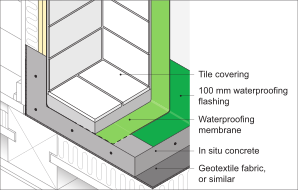
Figure 48. An example of watertight floor covering on a concrete slab and wall coverings on new stud walls constructed using an MK-approved tile setting system with a waterproofing membrane. To reduce the risk of cracks forming between floor and walls, the stud walls are anchored in concreted bases cast simultaneously with the concrete deck. The stud walls have a wet room plasterboard. The joints between stud walls and bases are reinforced with fibre strips or resilient waterproofing tape. The walls are waterproofed in their full height with a membrane from the MK-approved tile setting system. The membrane is continued unbroken down across the concrete bases, covering the whole floor. The floor tiles are bonded to the screed laid across the membrane on the concrete slab and the wall tiles are bonded to the watertight layer. The concreting substrate is pressure-proof mineral wool on pugging boards.
Floor |    |
This solution is applicable for load class M if a waterproofing membrane has been fitted across the concrete.
Wall in wet zone |    |
Wall in humid zone |    |
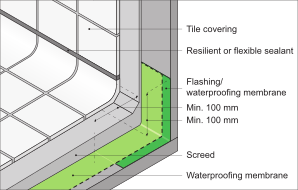
Figure 49. Detail of corner joint between floor and wall. The joint between floor and walls is flashed to ensure that it is watertight. The flashing consists of a reinforcement strip and the subsequent application of a waterproofing membrane. The flashing must be continued min. 100 mm across the floor area and min. 100 mm up the wall above the finished floor. In this example, the floor tiles are bonded to the screed on the concrete slab. The wall tiles are installed without a waterproofing membrane on a wall of inorganic material such as concrete, which is intrinsically watertight.
Floor |    |
This solution is applicable for load class M if a waterproofing membrane has been fitted across the concrete.
Wall in wet zone |    |
Wall in humid zone |    |
Walls in wet zones should be waterproofed prior to tiling.
3.4.4 Floor Gullies
Embedded floor gullies must be placed min. 60 mm away from timber joists and should carry a VA-approval for embedding into concrete. If possible, gullies with a vertical discharge spout should be used as pipes in storey partitions should be avoided.
Floor gullies are embedded so that they are surrounded by min. 60 mm concrete on all sides and normally min. 120 mm upwards. The weight of the concrete slab around the gully must be transferred to the joists (e.g., by means of two angle irons, each measuring 60 × 60 × 6 mm). The angle irons are placed crosswise between the joists, see figures 50 and 51.
If a waterproofing membrane is fitted to the concrete slab, the floor gully should be VA-approved for embedment into concrete with a watertight substrate (see Figure 51). In this case, the flange should be min. 40 mm wide to make a sealed joint between floor gully and membrane.
To ensure sufficient space around pipe penetrations, the clearance between pipes must be min. 60 mm while it should be min. 30 mm, between pipes and walls (see Figure 110 in Section 8.3, Wastewater Installations). For renovation work, complying with these measurements may mean having to move pipes, perhaps to a pipe shaft with an access hatch for carrying out inspection, repair, and replacement.
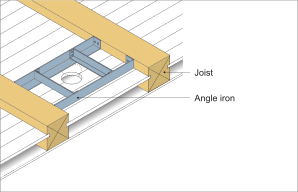
Figure 50. Positioning the floor gully in timber joist construction.
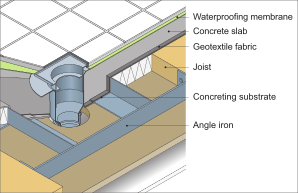
Figure 51. A floor gully embedded in concrete in an old timber joist construction. These should have vertical discharge spouts and not side outlets, as discharge pipes should neither be run in concrete embedment nor in joist constructions.
Floor gullies must be positioned min. 60 mm from joists to ensure effective embedment. The weight of floor gullies and concrete are transferred to the joists via angle irons measuring 60 × 60 × 6 mm.
Floor gullies must be positioned min. 60 mm from joists to ensure effective embedment. The weight of floor gullies and concrete are transferred to the joists via angle irons measuring 60 × 60 × 6 mm.
Floor |    |
This solution is applicable for load class M if a waterproofing membrane has been fitted across the concrete.
3.5 Light-Grade Double Floors
Sometimes, during renovation projects in multistorey buildings, it will be impossible to construct wet rooms using the in situ concrete method (e.g., where the foundations or timber joist constructions are incapable of absorbing the extra load form the concrete). In such cases, light-grade concrete floors can be used, comprising two light-grade floors separated by a water-resistant concrete layer. Water is drained off to the gully from both layers. This means that if the upper watertight layer/floor should leak, there will be a second layer to ensure that the construction is watertight.
The lower part of the construction is typically built as a light-grade floor construction as described in Section 3.3, Floors with Sheet Subfloors on Timber Joist Constructions. The floor is finished in the usual way with a waterproofing membrane (e.g., with a waterproofing membrane from an MK-approved tile setting system min. 1.0 mm thick, or PVC covering min. 1.5 mm thick).
A floor gully is installed in the construction and the membrane is sealed to this in a watertight joint. Any pipe penetrations should normally have collars or sleeves.
The bottom watertight layer, including collars or sleeves, is continued min.
50 mm up from finished floor level.
A separating film (e.g., geotextile fabric) is fitted to the bottom watertight layer and continued up all walls and as far as the opening in the floor gully. Following this, a new upper part is fitted to the floor gully, which will allow water to drain away from the watertight layer. When the upper part of the gully has been mounted, a 20–30 mm thick layer of light-weight water-resistant in situ concrete is cast, such as fibrous concrete or light aggregate concrete to reduce the weight (see Figure 52).
When the concrete has cured, a watertight floor covering is installed (e.g., an MK-approved tile setting system with a min. 1.0 mm waterproofing membrane).
Figures 52 and 53 show examples of light-grade double-floor constructions.
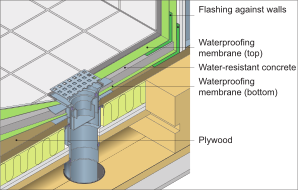
Figure 52. An example of a light-grade double floor. This construction includes a plywood floor installed on top of an existing timber joist construction. The lower watertight layer is a 1.0 mm membrane from an MK-approved tile setting system. The membrane is installed with sleeves around pipe penetrations, if applicable, and connected to floor gully. The watertight layer, including sleeves, is continued min. 50 mm up from finished floor level. Across the bottom watertight layer, a separating film comprising a double layer of geotextile fabric (not shown) is laid, on which approx. 30 mm of water-resistant light aggregate concrete has been cast. The finish is an approved tile setting system with a membrane identical to the one used in the bottom watertight layer.
Floor |    |
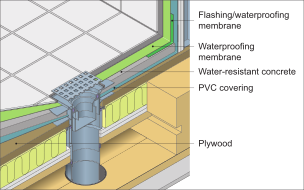
Figure 53. Example of light-grade double floor. The construction is identical to the one shown in Figure 52, only in this case, the bottom watertight layer consists of a special 1.5 mm PVC covering. Pipe penetrations are made with PVC collars and a clamping ring matching the PVC thickness is fitted to the lower part of the floor gully.
Floor |    |
3.6 Underfloor Heating
Underfloor heating systems are commonly used in wet rooms, partly to enhance comfort and partly to avoid radiators. However, a radiator might still be necessary in wet rooms in existing poorly insulated housing with underfloor heating.
Underfloor heating must not be installed under fixed cupboards and floor-mounted toilets. Prior to installing the heating tubes or cables, spaces for cupboards and floor-mounted toilets should be marked off to avoid placing the heating tubes or cables there. A floor-mounted toilet will typically take up approx. 300 × 400 mm.
For reasons of comfort, the floor temperature in bathrooms should be 27–29 °C.
Underfloor heating systems can normally be used without problems on heavy-grade deck constructions. When embedding heating pipes or cables in concrete or screed, there should be a layer of min. 30–50 mm concrete above the pipes or cables to achieve a uniform surface temperature (see Figure 54).
If the underfloor heating system is constructed with heater mats or foils, the thickness of the top concrete layer can be reduced.
In floors with subfloors of wood-based sheets, underfloor heating systems must not be placed so that any dimensional changes in the sheets resulting from the wood sheets drying will damage the waterproofing membrane or the floor covering. Therefore, floor heating systems should only be used if they can be embedded in screed laid on a separating film (e.g., two layers PE foil, each min. 0.20 mm thick, laid on top of the waterproofing membrane) (see Figure 55). Alternatively, a wet room floor designed for underfloor heating systems carrying an ETA or MK approval can be used (e.g., compatible for use on wood-based sheets with recessed grooves for the heating tubes).
The underfloor heating system should be turned off three days prior to tiling the floor and should not be turned on again before min. three weeks after the tiling has been completed.
Underfloor heating systems with their own separate heating loop and automatic controls should be used to limit underfloor temperature.
Further information on underfloor heating is available from the BYG-ERFA information sheet (43) 07 06 28, Gulvvarme og gulvtyper – isoleringsforhold, skader og gener (Underfloor Heating and Floor Types – Insulation, Damage, and Nuisance) (Byg-Erfa, 2007) and Gulvvarme (Underfloor Heating) (Buhl, 2013).
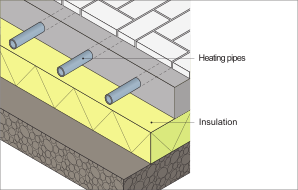
Figure 54. An example of a concrete deck construction with embedded heating pipes. To achieve an even heat distribution, the pipes must be covered by a 30–50 mm layer relative to their dimension and reciprocal distance. The example is shown as a ground floor slab in a single-family dwelling (i.e., a load class L floor). Therefore, there is no requirement for a floor waterproofing membrane.
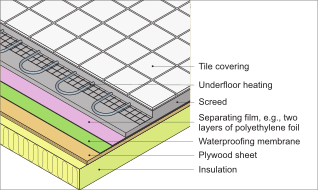
Figure 55. Example of light-grade deck on timber joist construction with plywood waterproofed by waterproofing membrane. Two layers of 0.20 mm PE foil has been laid on the plywood as a separating film; on top of this, a screed bed with embedded heating tubes. To achieve an even heat distribution, the pipes must be covered by a 40–50 mm layer relative to their dimension and reciprocal distance.