8 Plumbing Installations
This section describes water supply and wastewater installations for wet rooms. It provides general descriptions and prescriptions, including the function of the installations, plumbing issues, and connections. Incorporating water supply and wastewater installations into wet rooms is covered in Section 3, Floor Constructions, and Section 4, Walls.
Detailed information on water supply systems is available in SBi Guidelines 234, Vandinstallationer – funktion og tilrettelæggelse (Water Supply Systems – Function and Planning) (Brandt, Buhl & Monrad, 2011a), SBi Guidelines 235, Vandinstallationer – dimensionering (Water Supply Systems – Dimensioning) (Brandt, Buhl & Monrad, 2011b), and SBi Guidelines 236, Vandinstallationer – installationsdele og anlæg (Water Supply Systems – Installation Parts and Systems) (Brandt, Buhl & Monrad, 2011c).
Wastewater installations are treated in detail in SBi Guidelines 255, Afløbsinstallationer – systemer og dimensionering (Wastewater Installations – Systems and Dimensioning) (Brandt & Faldager, 2015a), SBi Guidelines 256, Afløbsinstallationer – anlæg og komponenter (Wastewater Installations – Systems and Components) (Brandt & Faldager, 2015b), and SBi Guidelines 257, Afløbsinstallationer – installationsgenstande og udførelse (Wastewater Installations – Fixtures and Fittings and their Installation) (Brandt & Faldager, 2015c).
8.1 General Issues
8.1.1 Rules, Marking, and Approvals
Water supply systems and wastewater installations must be installed according to the rules stipulated in the 2010 Building Regulations (Ministry of Transport, Building and Housing, 2010), with reference to DS 439, Code of Practice for domestic water supply systems (Danish Standards, 2009c), and DS 432, Wastewater installations (Danish Standards 2009b). Electrical installations must be installed according to the Statutory order on high-voltage power (Stærkstrøms- bekendtgørelsen) (Ministry of Business Affairs, 2001).
Floor gullies, fixtures, and other features, must be CE marked if covered by a harmonised product standard. Currently no requirements exist for floor gullies to be CE marked. As far as possible, it is recommended that VA approved fixtures and fittings be used for water supply systems and wastewater installations (see Annex E. Marking and Approvals) as this is the easiest way to ensure compliance with Danish requirements.
Water supply systems and wastewater installations (including floor gully connections) must be carried out by authorised plumbers. Sewer work must be carried out by authorised sewer contractors and electrical installations by authorised electricians.
8.1.2 Pipework – Plumbing Shafts
Pipework should be as short as possible. It is a good idea to lay pipes horizontally above suspended ceilings, avoiding pipe penetrations in floors and parts of walls that are most water exposed. Standing pipes (vertical pipework) are best run in an installation shaft.
An installation shaft is used:
- to provide a watertight partition between wet room and installation shaft. In this case, the outside of the shaft or pipe guard must be treated as part of the wet room walls and must be made watertight and flashed to form a watertight joint with the floor.
- to ensure that regular wall and floor surface areas are continuous and watertight, including the shaft. In this case, shaft walls can be made of any material as they will not be subject to standard requirements. However, materials resistant to both water and high relative humidity should always be selected
8.1.3 Detecting Leakages
As far as possible, water from leakages in the pipework must be prevented from infiltrating the construction. Empty conduit systems must be made to drain water from potential leakages to where it is readily detectable.
For installation shafts, potential leakages from pipes and components in the shaft must be detectable. This is ensured using a leak-detecting pipe run from the watertight and accessible shaft bottom to a place where the leakage is easily detectable. Leak detection could also be achieved by constructing the bottom of the shaft (e.g., under the bathtub or cistern with an incline and opening to the wet room), so that the water will run out on the wet room floor (see Figure 12), or an acoustic alarm could be fitted.
8.1.4 Access to Plumbing Shafts
If there are water pipe couplings, water- or electric meters, or other similar elements in the shaft, they should be accessible, potentially via a hatch from an adjacent room or if one side of the pipe guard is made to be detachable. If it is impossible to secure access to the shaft from rooms other than the wet room, the hatch must be constructed to fit tightly to the surrounding walls and be protected against splashing water (e.g., by fitting a screen).
Hatches should be big enough to facilitate inspection and minor repairs. The optimal solution is to make hatches big enough to allow a person through.
These rules also apply to shafts behind toilets (cistern shafts) and underneath bathtubs. There will usually be couplings in the water supply system in both of these locations.
Plumbing shafts should be constructed so that the installations that require checking or maintenance most frequently are easy to access (such as household water supply, valves, and water and electric meters). It is often a good idea to ensure that plumbing shafts are wide and not very deep, thereby facilitating access to the installations.
8.1.5 Pipe Penetrations
Pipe penetrations in floors should, as far as possible, be avoided; if this is not possible, they must be watertight. The best way to ensure this is to use watertight collar bushes, supply outlet boxes, and similar measures (see figures 91 to 93). However, no collar bush systems or supply outlet boxes are available for vertical cast-iron pipework (soil stacks) and existing pipes. Such penetrations will therefore have to be created on site by flashing them, potentially using sealing collars combined with a liquid waterproofing membrane as specified in the ETA or MK approval for the floor covering (if applicable). For PVC floor coverings, penetrations can be performed using a PVC collar welded to the covering.
Should it prove impossible to flash the pipes efficiently (if they are too close to a wall for example) a pipe guard or plumbing shaft must be fitted around the pipes. In this case, the pipe guard should be treated as part of the wall and should therefore be waterproofed and flashed against the floor (see Section 8.1.2, Pipework – Plumbing Shafts).
The number of penetrations should generally be kept to a minimum particularly in floors. Pipe penetrations should only be installed where no other option is feasible. No pipe penetrations in the floor are permitted in shower stalls and within 500 mm of shower stalls, bathtubs, or floor outlets (see Figures 2 to 6 in Section 1.5, Wet-Room Zones).
Pipe penetrations in tile coverings should, if possible, pass through a tile so that the collar bush remains within the tile perimeter. This will ensure optimal tightness between pipe penetration and floor or wall. For installations using PEX pipes, supply outlet boxes can be used.
Furthermore, ventilation ducts, and similar solutions, must be installed with watertight joints against the building parts they run through. This avoids water exposure and infiltration of the ducts, and avoids humid indoor air from infiltrating surrounding constructions. Penetrations can be performed according to the same guidelines which apply to water and waste pipes.
8.1.6 Watertight Couplings
Sleeve systems, supply outlet boxes, and similar elements, must be fixed in such a way as to avoid leakages through use. They must be coupled in a watertight joint to:
- the penetrating pipes
- the watertight layers in floors and walls
- floor or wall surfaces.
Normal use or repair of plumbing installations must not potentially break the watertight couplings.
To ensure sufficient space around pipe penetrations, the clearance between pipes and adjoining floors and walls should meet the requirements in Figure 110 in Section 8.3, Wastewater Installations. Compliance with these measures could entail moving pipework when renovating. A plumbing shaft or pipe guard with a hatch could be built to facilitate inspection, repair, or replacement.
8.2 Water Supply Installations
8.2.1 Rules and Guidelines
Requirements for water supply installations are stipulated in the 2010 Building Regulations (Ministry of Transport, Building and Housing, 2010), with reference to the water standard (DS 439, Code of Practice for domestic water supply systems (Danish Standard, 2009c)). Detailed information on water supply systems is available in SBi Guidelines 234, Vandinstallationer – funktion og tilrettelæggelse (Water Supply Systems – Function and Planning) (Brandt, Buhl & Monrad, 2011a), SBi Guidelines 235, Vandinstallationer – dimensionering (Water Supply Systems – Dimensioning) (Brandt, Buhl & Monrad, 2011b), and SBi Guidelines 236, Vandinstallationer – installationsdele og anlæg (Water Supply Systems – Parts and Systems) (Brandt, Buhl & Monrad, 2011c).
8.2.2 Pipe Couplings
Pipe couplings and couplings between piping and fixtures must not be concealed in walls and floors, rather they must be accessible for inspection, repair, and replacement (see DS 439, Code of Practice for domestic water supply systems) (Danish Standards, 2009c). Hot water supply systems should only be run in empty conduits.
The most common piping system for water supply is the so-called empty-conduit system with integral detection of leakages. Inside the empty-conduit system, the actual water supply is run in PEX pipes. The PEX pipes are run inside a corrugated plastic tube, so that water from potential leakages in the PEX pipe can be drained off to the outer tube in a spot where it will be visible. Couplings in the PEX-pipe system will typically only occur at supply pipe level and at the point of use or fixture.
Several stainless-steel pipe systems are in use which are typically coupled with compression fittings. Stainless-steel pipes are mainly used for visible pipework.
8.2.3 Securing Fixtures, etc.
Wet room usage, including fixtures, must not cause the watertight layers in the walls or facing to come loose or break at the anchorage points. Fixtures, supply outlet boxes, support brackets, and other fixtures must therefore be securely anchored and stable to avoid leakage through use.
Stud walls must be reinforced with nogging or bits of sheeting to which the fixtures must be secured. Pipework must be fixed to studs, noggings, or cross struts with pipe supports. If the pipework will be covered by a panel, the walls’ watertight layers or facing must be continued behind pipes and panels (see Section 8.1.2, Pipework – Plumbing Shafts).
Figures 91 to 93 show examples of watertight penetrations in wet room floors and walls. Generally, pipe sleeves should be firmly fixed so that no leakages will occur through use and to facilitate repairs without damaging the watertightness.
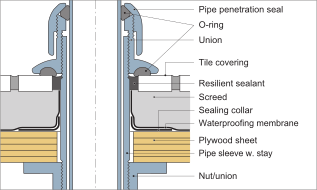
Figure 91. An example of a floor pipe penetration with tiles bonded to screed on a watertight layer of 18-mm plywood subflooring. The sleeve is fixed by tightening it against a nut at the other end of the pipe sleeve and pulling it tight. The pipe sleeve is sealed to the floor’s watertight layer with a sealing collar bonded to the substrate. Furthermore, sealing collar and pipe sleeve are waterproofed according to the MK approval. Resilient sealant is used between pipe sleeve and tiles. An O-ring tightened with a union is used to seal the area between collar bush and floor.
Likewise, an O-ring tightened with a pipe penetration seal is used to seal the area between collar bush and pipe
Floor |    |
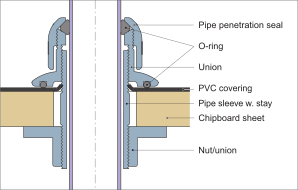
Figure 92. An example of a pipe penetration in a floor with PVC covering on a 22-mm plywood subfloor. The collar bush is fixed by tightening it against a nut at the other end of the pipe sleeve, pulling it tight. The pipe sleeve comes through the PVC covering via a hole that is a few mm smaller in diameter than the pipe sleeve. An O-ring tightened with a union is used to seal the area between collar bush and floor. Likewise, an O-ring tightened with a pipe penetration seal is used to seal the area between collar bush and pipe.
Floor |    |
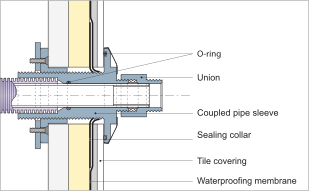
Figure 93. An example of a penetration with wall-mounted coupling in a stud wall with watertight tile setting system on a substrate of one layer of 12.5 mm plasterboard and one of 12 mm calcium silicate sheets. The coupling is screw-fixed to a cross strut integrated into the stud. A sealing collar is used to seal the area between pipe sleeve and wall. Furthermore, the sealing collar and pipe sleeve are waterproofed according to the MK approval. The collar bush is installed with an O-ring to seal the area between the collar bush and pipe. Likewise, the area between the collar bush and wall is sealed with an O-ring tightened by a union where the pipe sleeve flange acts as a stay.
Wall in wet zone |    |
Wall in humid zone |    |
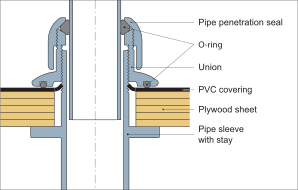
Figure 94. Waste outlet coupling in PVC flooring on an 18 mm plywood subfloor. The pipe sleeve comes through the PVC covering via a hole that is a few mm smaller in diameter than the pipe sleeve. The area between the collar bush and floor is sealed with an O-ring tightened by a union where the pipe sleeve flange acts as a stay. Likewise, the area between collar bush and pipe is sealed with an O-ring tightened by a pipe penetration seal.
Floor |    |
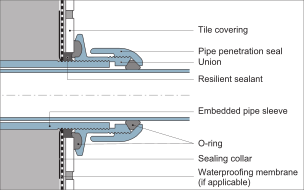
Figure 95. An example showing a pipe penetration in a tiled brick or cast wall. The collar bush is retained by embedding it in the wall. The area between collar bush and wall is sealed with a sealing collar and possibly a watertight layer. The area between the collar bush and wall is sealed with an O-ring tightened by a union whereas the area between the collar bush and the pipe is sealed with an O-ring tightened by a pipe penetration seal. A similar collar bush can be used for pipe penetrations in tiled floors on concrete decks, or similar constructions.
Wall in wet zone |    |
Wall in humid zone |    |
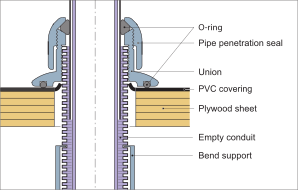
Figure 96. An example of a pipe penetration in a floor with PVC covering on an 18-mm plywood subfloor. The collar bush is designed for use with empty conduits. Since the collar bush is not fixed by tightening, the empty conduit needs to be fixed (e.g., with a bend support placed below the floor). The empty conduit comes through the PVC covering via a hole that is a few mm smaller in diameter than the empty conduit. The area between collar bush and floor is sealed with an O-ring tightened by pressing the union down across the empty conduit. Likewise, the area between collar bush and pipe is sealed with an O-ring tightened with a pipe penetration seal.
Floor |    |
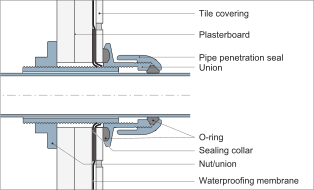
Figure 97. A pipe penetration in stud wall with 2 × 12.5 mm plasterboard covered with watertight MK-approved tile setting system. The collar bush is fixed by tightening it against a nut at the other end of the pipe sleeve and pulling it tight. The area between collar bush and watertight layer in the tile covering is sealed with sealing collar (shown here in reduced size). Furthermore, the sealing collar and pipe sleeve have been waterproofed in accordance with the MK approval. The area between collar bush and tile covering is sealed with an O-ring tightened by a union whereas the area between the collar bush and the pipe is sealed with an O-ring tightened by a pipe penetration seal.
Wall in wet zone |    |
Wall in humid zone |    |
Figures 98 to 101 show examples of watertight penetrations installed with wall-mounted couplings and supply outlet boxes for coupling piping and fixtures for wall installation.
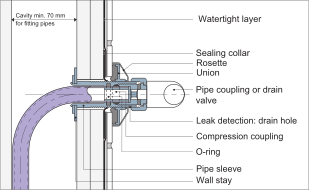
Figure 98. A vertical section in a pipe penetration with a wall-mounted coupling used for connecting a mixer tap. The fixture is mounted on a stud wall with 2 × 12.5 mm gypsum board and an MK-approved tile setting system with waterproofing membrane. The two couplings are fixed to a joint pressure distribution plate which is fixed to the inside wall between the pipes. The area between coupling and wall is sealed with a resilient sealing collar. Furthermore, the sealing collar is waterproofed in the process of waterproofing the wall. The area between coupling and pipe is sealed with an O-ring and an O-ring is tightened with a union to seal the penetration with the wall surface. Tightening the union also fixes the wall-mounted coupling against the wall while the pressure distribution plate acts as wall stay.
Wall in wet zone |    |
Wall in humid zone |    |
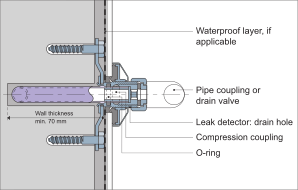
Figure 99. A vertical section in a pipe penetration with wall-mounted coupling for a pipe coupling or drain valve in a tiled brick or cast wall. The coupling is mounted with an offset plate screw-fixed to the wall in drilled-in plugs. The feed pipe is installed from the outer side of the wall which must be min. 70 mm thick to allow for making recesses for the mounting plate and piping. The recesses are filled in once the installation is complete. The area between tile covering and coupling is sealed with resilient sealant. For watertight tile setting systems, use a resilient sealing collar between coupling and watertight layer in the covering as shown in Figure 98. Other sealing procedures should be carried out as shown in Figure 98.
Wall in wet zone |    |
The solution is applicable in load class H, always assuming that a waterproofing membrane is used.
Wall in humid zone |    |
The solution should only be applied in load class H if a waterproofing membrane is used.
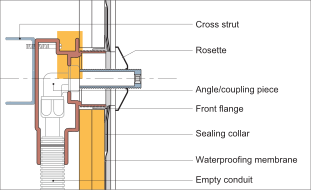
Figure 100. A section of a supply outlet box for a connecting pipe or drain valve in a stud wall with a double layer of sheet covering and an MK-approved tile setting system, including a waterproofing membrane. The supply outlet box is fixed to a cross strut in the stud. Sealing against the wall is done with the front flange of the supply outlet box, fitted from the front side of the wall. Furthermore, a sealing collar is fitted over the front flange. Finally, a waterproofing membrane is applied when waterproofing the wall (see Figure 101).
Wall in wet zone |    |
Wall in humid zone |    |
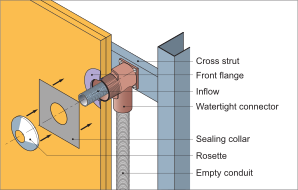
Figure 101. Supply outlet box mounted in stud wall. A sectional view of this construction is shown in Figure 100.
8.3 Wastewater Installations
8.3.1 Wastewater Installations – Principles
The requirements for wastewater installations are stipulated in the 2010 Building Regulations (Ministry of Transport, Building and Housing, 2010), with reference to the wastewater standard, DS 432, Code of Practice for domestic water supply systems (Danish Standard, 2009b). Detailed information on wastewater installations is available in SBi Guidelines 255, Afløbsinstallationer – systemer og dimensionering (Wastewater Installations – Systems and Dimensioning) (Brandt & Faldager, 2015a), SBi Guidelines 256, Afløbsinstallationer – anlæg og komponenter (Wastewater Installations – Systems and Components) (Brandt & Faldager, 2015b), and SBi Guidelines 257, Afløbsinstallationer – installationsgenstande og udførelse (Wastewater Installations – Fixtures and Fittings and their Installation) (Brandt & Faldager, 2015c).
Wastewater from toilets, washbasins, showers, and other sources merge in a soil stack transporting the water to a public sewer or a private collection tank. Soil stacks in multistorey buildings often pass through several flats and must therefore not be built using flammable materials. Either cast iron or stainless steel is used. Where no fire requirements exist, plastic piping can be used.
Wastewater installations should be constructed with sufficient falls to ensure good drainage and to ensure that pipes self-clean. Waste pipes must be fixed, chiefly to prevent pipe connections from coming apart.
Contrary to water supply systems, wastewater installations can be constructed with concealed couplings as there is no water pressure in these pipes.
There are no requirements stipulating approvals for wastewater installation materials. Nevertheless, as far as possible it is advisable to use VA-approved floor gullies, etc., because this provides documentation for all relevant properties, including national requirements for documentation of physical and mechanical properties.
When renovating bathrooms and replacing cast-iron soil stacks, it might be an advantage to leave the part of the stack located inside the storey partition behind. A new stainless-steel soil stack of a slightly smaller dimension than the existing one can then be installed through the remaining part of the former stack. Extra work may be necessary to waterproof around soil stacks renovated in this way.
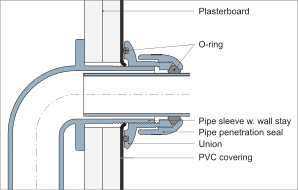
Figure 102. A waste outlet coupling in a stud wall with 2 × 12.5 mm plasterboard with PVC covering. The sleeve is fixed by tightening it. The flange on the pipe sleeve acts as a wall stay. The pipe sleeve comes through the PVC covering via a hole that is a few mm smaller in diameter than the pipe sleeve. The area between the collar bush and PVC covering is sealed with an O-ring tightened by a union whereas the area between the collar bush and the pipe is sealed with an O-ring tightened by a pipe penetration seal. If the wall is painted or tiled, sealing should be carried out as shown in Figure 96.
Wall in wet zone |    |
Wall in humid zone |    |
8.3.2 Floor Gullies
Generally
Floor gullies are the most exposed and critical part of wastewater installations. The floor gully should finish flush with the floor surface and should be properly fixed relative to the floor construction and watertight layer to avoid leakages. Floor gullies should be selected to match the chosen floor covering (e.g., a concrete floor gully with waterproofing membrane and tiles). Furthermore, the floor gully should be positioned at the correct height, facilitating the floor to be constructed with slopes towards the
gully. Floor gullies are available with a sliding upper part or with ancillary height-adjusting frames. The upper part or the height-adjusting frames must be an integral part of the floor gully installation.
When renovating, it will usually be necessary (and recommended) to replace the floor gully. Existing floor gullies, such as cast iron gullies, must not be repaired or extended with height-extending frames or a cast edge at the top (see Figure 103). Further information is available from the BYG- ERFA info sheet (50) 10 11 30, Vådrum – gulvafløb og afløbsledninger (Wet Rooms – Floor Gullies and Waste Pipes) (Byg-Erfa, 2010).
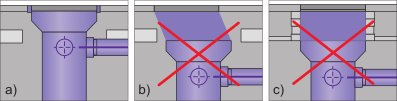
Figure 103. Gulvafløb skal ende ved gulvoverfladen, se afløbsnormen, DS 432 (Dansk Standard, 2009b). Det er ikke tilladt at forhøje et eksisterende afløb med forhøjningsrammer eller en støbt kant i beton. Hvis gulvkonstruktion eller -belægning skal ændres, må gulvafløbet derfor som hovedregel udskiftes.
Installation instructions, approvals, and other documentation will specify floor gullies as ‘designed for embedding’ or ‘designed for use with waterproofing membrane’. As such, installation instructions and approvals do not state whether integration is possible in real terms (e.g., whether it is possible to bond a waterproofing membrane to the floor gully flange). Consequently, contractors should personally ensure that the materials used are compatible, potentially by obtaining the necessary documentation from the gully manufacturer.
Types of Floor Gullies
Floor gullies come in different types: traditional round or square ones, channel drains, or corner drains. Old gullies may be cast iron while more recent ones will typically be made of stainless steel or plastic. Examples of floor outlet designs are shown in Figures 104–108.
Gully types:
- Standard gully for embedding in concrete or installed in a floor made of sheeting. The gully is also available in a version designed for use with waterproofing membranes. If the membrane or collar which form part of the waterproofing system is bonded in place, the flange should be min. 40 mm wide (see Figures 104 and 105).
- Channel drains which come in two types. One is designed for use on the floor away from walls while the other is designed to be used against a wall (see Figure 106).
- Corner drains designed for use in corners against two walls (see Figure 107).
- Shower drains or mini drains designed for use in shower stalls. Shower drains normally come in smaller dimensions than ordinary floor gullies and do not usually incorporate wastewater- or stench traps. Hence they are only suitable as supplement to another gully (i.e., the water is drained to a
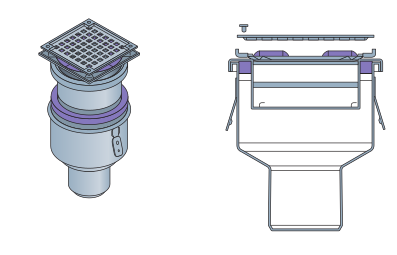
Figure 104. An example of a standard gully designed to be embedded in concrete. The gullies are usually made of stainless steel or plastic and may have a flange for bonding with a collar or waterproofing membrane.
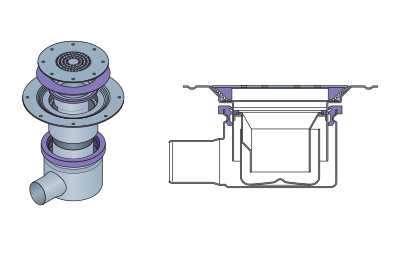
Figure 105. An example of a standard gully designed for use with PVC or other prefabricated waterproofing membranes. The outlets are usually made of stainless steel or plastic. They have a clamping ring which provides a watertight joint between the covering and the gully and secures the floor covering.
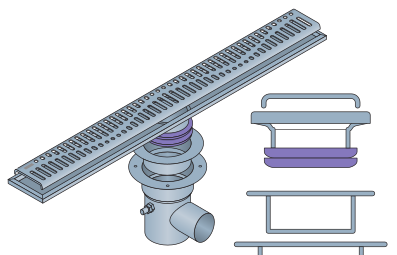
Figure 106. An example of a channel drain which comes in two types. One is designed for use on the floor away from walls while the other is designed to be used against a wall. In the latter case, the manufacturer must be able to document that the gully is suitable for installation against a wall. Documentation that these requirements are met could be an ETA or MK approval
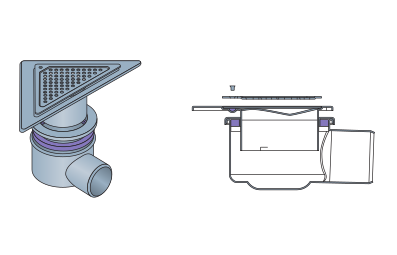
Figure 107. An example of a corner drain. Corner drains are always used against walls and manufacturers must be able to document that the outlet is suitable for installation against a wall. Documentation that these requirements are met could be an ETA or MK approval.
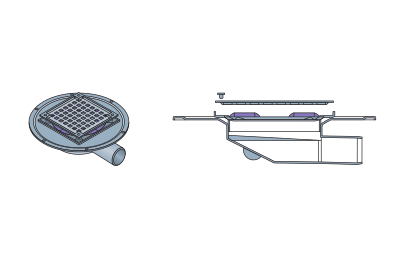
Figure 108. An example of a shower drain. Shower gullies are usually made of stainless steel or plastic. Shower gullies have smaller dimensions than standard waste outlets. They are connected to the drainage system via a side inlet to a standard floor gully and do not therefore require a separate wastewater trap.
Wastewater Trap
Floor gullies must have a trap to prevent odour nuisance. Recent gullies usually come with integrated traps (see Figure 104 to 107). Stall shower gullies can be installed without a trap because the gully is connected to a side inlet in the main floor gully. Furthermore, it is possible to make traps by shaping the waste pipes as P- or S-locks in the traditional way (see Figure 109).
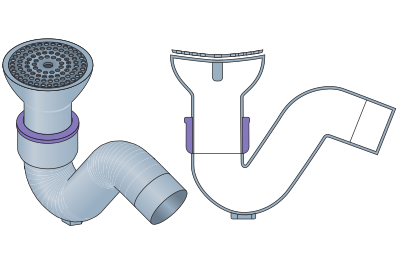
Figure 109. Traditional cast-iron outlet with trap constructed from waste piping. Similar solutions are feasible for modern outlet types.
Positioning Floor Gullies and Pipe Penetrations
To ensure buildability (i.e., the feasibility of doing the job correctly) pipe penetrations must be positioned so that it is possible to make watertight couplings. Figure 110 shows the distances between walls and pipework and floor gullies necessary to ensure correct installation.
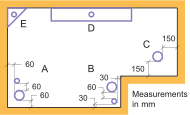
Figure 110. Positioning penetrations and floor gullies.
- Penetrating a vertical cast iron pipe (soil stack) or pipe which cannot be moved for renovation work. On-site flashing. If PVC coverings are used, spacing of up to 100 mm may be necessary to effectively install flashing.
- Water or waste pipe penetrations with prefabricated collar bush.
- Position of floor gully relative to wall. Spacing between the wall and edge of gully base.
- Channel drain positioned against wall.
- Corner drain positioned against wall
When using channel or corner drains positioned against walls, documentation must be available proving their suitability for integration into the construction for this to be watertight (e.g., in the form of an ETA or MK approval).
8.4 Electrical Appliances – Zoning
In Stærkstrømsbekendtgørelsen (The Statutory Order on High-Voltage Power) (Ministry of Business Affairs, 2001), the term ‘shower areas’ is used to denote the areas in a wet room in and around shower stalls and bathtubs. A distinction is made between four areas, depending on the water and moisture exposure anticipated (see the Statutory Order on High-Voltage Power). Appliances in shower areas, including lamps, should have a so-called enclosure rating relative to the area where they will be used.
The areas are defined as follows (see Figures 111 and 112):
- Area 0: The wettest part of the bathroom. This area includes the inside of the bathtub or the base of the shower stall and is furthermore limited vertically by the surface area surrounding the bathtub or shower base. For showers without a base, the area is limited vertically by a curved surface area with a radius of 0.6 m from the normal position of the shower head while showering and horizontally by the floor and a plane 50 mm above finished floor level.In area 0, the following enclosure rating is required: IPX7.
- Area 1: The area above a bathtub or shower base limited vertically by a plane encircling the bathtub or shower base and a horizontal plane 2.25 m above the floor. For showers without a base, the area is limited vertically by a curved plane with a radius of 0.6 m from the normal position of the shower head during use. Furthermore, area 1 includes the space under the bathtub or shower base, regardless of whether it is open or covered.In area 1, the following enclosure rating is required: IPX4.
- Area 2: The part of the room adjacent to area 1 and 0.6 m beyond this perimeter. Area 2 includes the area up to 2.25 m above floor level.In area 2, the following enclosure rating is required: IPX4.
- Area 3: Limited horizontally to max. 2.40 m outside area 2 at a height of 2.25 m above the shower area floor.Furthermore, area 3 includes the area above area 1 and area 2 up to the ceiling, or to a height of 3.0 m above floor level (depending on which is lower).In area 3, the following enclosure rating is required: IPX0.
For areas further away than 2.4 m outside area 2, or a height exceeding 2.25 m above floor level in area 3, no enclosure ratings are required.
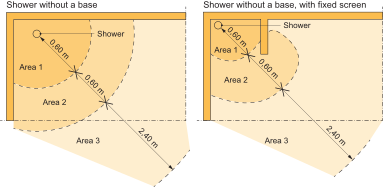
Figure 111. The zoning of a wet room for the placement of electrical appliances in wet rooms with showers (see the Statutory Order on High-Voltage Power) (Ministry of Transport, Building and Housing, 2001).
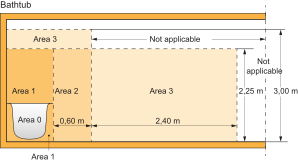
Figure 112. The zoning of a wet room for the placement of electrical appliances in wet rooms with bathtubs (see the Statutory Order on High-Voltage Power) (Ministry of Transport, Building and Housing, 2001).
The provisions do not apply to emergency showers (e.g., in industrial enterprises and laboratories). If hosing down is anticipated (e.g., in common shower facilities) the materials are required to meet enclosure rating IPX5, at minimum.
Since showering persons, or people who have just finished showering are particularly sensitive to electric shocks, electrical appliances in shower areas are subject to stringent requirements. Requirements for cable systems apply to both visible cable systems and cable systems placed in floors, walls, or ceilings at a depth of up to 50 mm. In areas 0, 1, and 2, only cable systems supplying fixtures in the relevant areas are permitted.
The requirement for coupling equipment, power switches, and power sockets vary in the different areas. Power sockets can only be installed in area 3 and those parts of the shower area where zoning does not apply. Power sockets installed in the shower area (also beyond area 3) must be protected to the same standard as area 3. If the ceiling height exceeds 2.25 m, no power sockets are permitted in the part of area 3 that includes the space above areas 1 and 2.
Connection points for permanent fixtures, such as ventilators or a bidet, must be placed in area 3 or in the parts of the shower area where zoning does not apply. However, junction boxes are permitted in area 2 if they meet the enclosure rating. It is permitted to connect a washing machine in areas 1 or 2 because a washing machine does not count as a permanent fixture. In this case, the min. enclosure rating of IPX4 applies (see the Statutory Order on High-Voltage Power) (Ministry of Transport, Building and Housing, 2001).