2 Choice of Materials and Constructions – General Considerations
Prior to the selection of materials and construction products, the usage and anticipated load of a wet room must be clarified (see Section 1, Basic Requirements and Recommendations).
This section specifies how to select materials and construction products relative to the usage of the wet room, especially its anticipated load.
Specific solutions are outlined in the remainder of these Guidelines. Table 3 in Section 3.1.4, and Tables 6 and 7 in Section 4.1.2 state the load classes in which different combinations of constructions and waterproofing systems can be used.
2.1 Lifespan
The materials and constructions used are of great significance to the performance and lifespan of wet rooms. Therefore, the products used should be subject to rigorous performance and quality standards.
The lifespan of a wet room is difficult to predict. Materials and constructions with the following characteristics will prolong the lifespan:
- Robust materials and constructions which are cheap and simple to repair and where the consequences of minor damage are small.
- Simple rooms and constructions which are easy to build. Solutions that are simple to implement will reduce the risk of error and thus aid in prolonging the lifespan.
- Solutions that comply with the chosen construction method and using compatible materials. For renovations, the solutions must be compatible with the original materials and constructions.
For renovations, special issues such as weak foundations, seasonal constructional movement, shrinkage, and settlement must be considered when used. Ensure that the walls in the wet room will not unintentionally have to absorb load due to deformations in the building structure.
2.2 Floor and Wall Performance
2.2.1 The Function of Floors and Walls
The performance of floors and walls in wet rooms must, at minimum, ensure that the following requirements are met:
- Floors and walls (including joints, connections, and pipe penetrations) must be watertight.
- Floors and walls must be capable of resisting normal usage load, such as foot traffic, fixtures, and people bumping against floors and walls.
- Floors must be safe to walk on.
- Constructions exposed to water load must be resistant to hot- and cold-water exposure.
- Floors and walls must be resistant to deformation occurring due to seasonal changes in relative humidity.
- The constructions must be resistant to deformations resulting from the drying of construction-related moisture.
- Floor and wall surfaces must be easy to clean and suited to ordinary cleaning, common detergents, etc. For any materials used which do not tolerate acidic detergents, such as marble, specific cleaning guidelines should be prepared or obtained, explaining how to remove limestone deposits.
- If wet rooms are likely to be subject to chemical exposure (particularly in industry), the affected floor and wall surfaces must be resistant to anticipated exposure.
- Constructions and surface areas must be designed to be buildable, including the planning of complex details (e.g., positioning pipes close to walls).
2.2.2 Watertightness
Watertightness can be achieved as follows:
- The construction can be made intrinsically watertight (e.g., in the form of a concrete wall or deck in a good quality concrete such as C20/25 according to DS/EN 206-1, with tight joints) (see Section 3, Floor Constructions and Section 4, Walls).
- The construction can be built with one of the following watertight surfaces:
- Watertight flooring, such as PVC
- Watertight layer, such as a waterproofing membrane in liquid or roll form protected by a tiled surface (known as a watertight tile setting system)
- A paint application (i.e., a wet room paint application kit).
The watertight surface area must protect all underlying parts against moisture (see Section 6, Watertight Membranes, Claddings and Paint Systems). - The construction can be done using a watertight layer inside the construction (e.g., a rubber membrane or plastic foil) which will protect moisture-sensitive parts located further inside the construction. The parts in front of the watertight layer must be resistant to water and humidity (i.e., be damp-proof) (see Sections 3, Floor Constructions and 4, Walls).
Depending on the selected construction product, floor and wall surfaces can be finished with tiles, PVC, a paint application, a wooden covering, or similar finishings. The possible combinations are listed in Table 3 in Section 3.1.4 and Tables 6 and 7 in Section 4.1.2.
Joints must also be watertight (e.g., between floor and walls, in the wall corners, and around floor gullies and pipe penetrations). The watertightness of joints and penetrations is highly dependent on the choice of materials and how carefully the work is carried out.
Note that the watertightness of a construction should not only be based on the use of resilient sealant (see Section 7.1, Joints).
Watertight coverings and layers, including joints, must not fail due to construction or material movement (e.g., dimensional changes resulting from variable moisture content or variable temperature such as moisture movement in sheeting or deflection in floors).
Flooring, membranes, and paint systems must be continuous and must not be discontinued or omitted near bathtubs and permanent fixtures (see Figure 12). Floor coverings or waterproofing membranes must be sealed to the floor gully in a watertight joint.
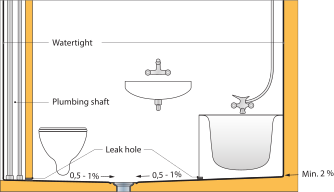
Figure 12. The watertight layer in a bathroom must be continuous and cover all wall and floor surface areas, including concealed areas underneath bathtubs and in cistern shafts, ensuring that no water can infiltrate the underlying constructions. Water from the whole floor must be drained off to a floor gully, including water from under the bathtub and in plumbing shafts installed on the floor (i.e., the floor must be sloped). To detect leaking water from a shaft or under a bathtub, a so-called leak detection hole could be made. This will cause any water to run out to a visible location. The floor under a bathtub and the bottom of shafts should therefore be constructed with slopes towards a leak detecting hole/pipe. There must be access (e.g., via an access hatch) to pipe couplings hidden in the plumbing shaft or under the bathtub.
2.2.3 Joints Between Floors and Walls
Joints between floors and walls must be watertight to prevent water from infiltrating storey partition decks or walls. The design of the joint depends on the construction type:
- Constructions considered intrinsically watertight:The joint is protected by flashing (i.e., it has a watertight covering over the joint) (see Figure 13).
- Constructions with a waterproofing membrane in the floor or watertight floor covering:The membrane or floor covering is continued unbroken min. 100 mm up the walls measured from the face of the finished flooring. Furthermore, the membrane or floor covering must overlap or be joined to the watertight wall covering or paint application (see Figures 14 and 15).
If the watertight floor covering is made from PVC, it is sufficient to continue the covering 60 mm up the wall, assuming that PVC will be used for the wall as well. This assumes that the two materials will weld together.
The nature of the construction will ultimately determine how to combine the schematic solutions shown. If the floor is intrinsically watertight, but the walls are not, a ‘pool’ effect can be obtained by continuing the watertight layer or watertight covering down to the floor and, unbroken, min. 100 mm out across the floor. If this technique is used, all joints between the walls and the floor must be watertight.
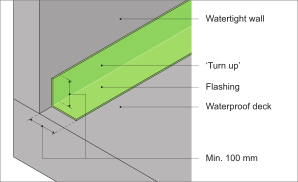
Figure 13. The walls and floor are intrinsically watertight (e.g., built in concrete). Watertight joints are obtained by flashing the joints between floor and walls. The flashing is continued min. 100 mm up the wall and min. 100 mm across the floor
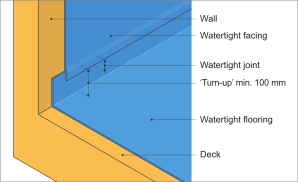
Figure 14. Making the walls and floor watertight using a watertight covering. A ‘pool’ effect is achieved by continuing the watertight floor covering unbroken min. 100 mm up the walls and fixing it to the walls at its full extension. Watertight joints are obtained using lap joints where the watertight wall facing is continued over the flooring material with an upturned overlap of min. 30 mm. This results in a base height of 70 mm.
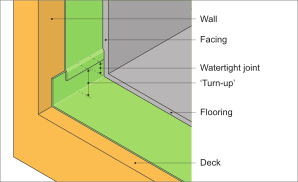
Figure 15. Watertight walls and floors are achieved using a watertight layer between the wall and floor constructions. The layers in the floor and on the walls facing the bathroom must be resistant to steady water or humidity impact. The ‘pool’ effect in this example is achieved by continuing the watertight layer in the floor construction unbroken up the walls, fixing it to the walls in its full extension, and sealing it to the watertight wall layers in a watertight joint.
Lap joints must overlap by at least 30 mm. If made of PE foil, they must overlap by min. 50 mm. To protect visible moisture-sensitive lap joints against splashback from the floor such as board facings and paint applications (see Figures 16 and 17), the base height should be min. 100 mm.
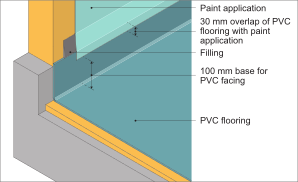
Figure 16. Example of painted wall and PVC flooring. The PVC flooring is continued 130 mm up the wall and overlapped by min. 30 mm of the wet room 120paint system, obtaining a base height of 100 mm.
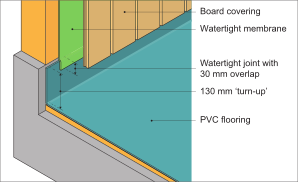
Figure 17. An example of a board covering with waterproofing membrane. The PVC flooring is continued min. 130 mm up the wall. The wall membrane overlaps the PVC flooring by min. 30 mm. To protect moisture-sensitive materials against splashback, the base height should be min. 100 mm.
2.2.4 'Pool' Effect
Doorsteps and kerbs (if applicable) and the watertight connections between floor and walls will (together with the slope on the floor) cause the floor to act as a pool, capable of holding an amount of water (see Figure 18). The floor area by the door must be the highest spot in the room. The watertight layer in the floor (or watertight floor covering) must always be joined in a watertight joint to the bottom door casing or floor in the adjacent room.
If the gully in a wet room is blocked, the ‘pool’ effect facilitates action to be taken before water from a leaking water installation, a defect washing machine, or similar, escapes into adjacent rooms. Figures 18–20 show examples of floors near doors in wet rooms.
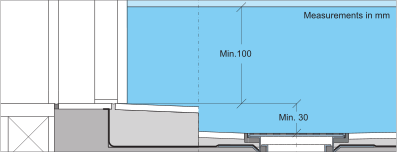
Figure 18. An example of the details by a door without bottom casing. The floor is constructed with a 1 % slope towards the floor gully and is flush with the floor in the adjacent room to allow wheelchair users/walking-impaired persons to access the room. The vertical distance between the floor area by the door and the upper side of the floor gully must be min. 30 mm to ensure that the floor acts as a pool. The wet room in this example is shown with floor tiles on a screed bed on concrete and the floor in the adjacent rooms as a timber floor on joists.
Floor |    |
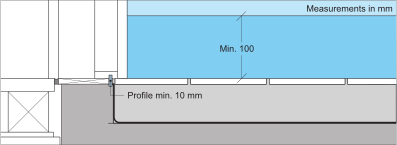
Figure 19. The materials are identical to those in Figure 18, but the floor by the door is virtually horizontal (i.e., with very slight slope and flush with the floor in the adjacent room to allow for wheelchair users/walking-impaired persons). Although floors must be constructed with slight slopes (almost horizontal), there must be no depressions (causing ponding) and it is advisable, therefore, always to construct well-defined slopes towards the floor gully. The vertical distance between the floor area by the door and the upper side of the floor gully must be min. 30 mm to ensure that the floor acts as a pool. If the slope by the door is less than 1 %, a min. 10 mm high watertight profile must be fitted to the doorstep to prevent water from running out of the door.
Floor |    |
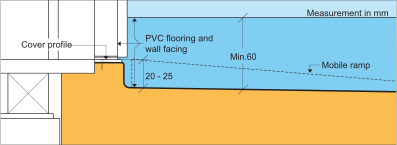
Floor 20. An example of a door opening with a min. 20 mm high kerb to ensure that the floor acts as a pool. To allow wheelchair users and walking-impaired persons to access the room, the kerb must be max. 25 mm high. The floor in the wet room in this example is shown as PVC flooring. The PVC flooring is continued 60 mm up the wall and welded to the PVC cwall overing. The floor in the adjacent room is a timber floor on joists.
Floor |    |
2.2.5 Delimiting the Shower Area
Water is best prevented from spreading across the whole floor when showering by making the shower stall recessed approx. 10 mm into the floor. A recess allows water from the whole floor area to flow to the same gully. The floor gully is placed in the recess and the floor is laid with slopes (normally between 1 and 2 %). In the remaining part of the room, the floor can be laid with a smaller gradient towards the recess (e.g., 0.5 %). It is not advisable to lay the floor completely level because this introduces a major risk of back sloping or depressions. The recessed area should be large enough to allow water from the shower curtain to drip off into the recess.
Kerbs around shower areas should be avoided as far as possible. If a kerb is built, it must be max. 25 mm high to allow for persons with physical disabilities and a floor gully must also be installed in the floor outside the shower stall.
2.2.6 Moisture-Induced Movement
The dimensions of wood, plywood, and particle board will change in tandem with a varying moisture content (see e.g., SBi Guidelines 224, Dampness in Buildings (Brandt, 2013)). During the construction work, the water content of joists and other materials must not exceed an average of 13 % and no single value should exceed 15 %. If the moisture content is higher or if there is a risk of moisture sorption, the installation of floor and wall coverings should be delayed until the timber has dried out.
Joints should be designed to allow for seasonal moisture-induced movement to occur without the risk of cracks or leakages in the watertight layers, flooring, and facing.
2.2.7 Compatible Materials
Primers, adhesives, fillers, degreasing agents, sealants, welding wire, and other materials used as ancillary materials when laying floors and installing wall coverings must be compatible with one another as well as with the chosen floor and wall covering materials.
The compatibility also applies to the physical interaction between the materials (e.g., rigid surface coverings require a stable and rigid substrate).
Materials (particularly their surfaces) must be resistant to the impact anticipated during use, including the use of acidic detergents in bathrooms or chemicals in industry.
No materials must emit harmful gases such as formaldehyde.
2.3 Constructing Bathrooms in Old Buildings
Wet rooms built in existing houses are primarily bathrooms. Essentially the same provisions apply for these as for new builds. However, there will almost always be edge cases requiring special attention. When old timber joist constructions or half-timbered walls feature in wet rooms, special attention must be paid to rigidity to prevent wet room constructions from being damaged by potential deformations in adjacent building parts. The special issues that apply to existing buildings mean that construction systems will often deviate from those in new builds.
When constructing bathrooms in old buildings, there is a special risk of cracks appearing between the new and old building parts. This could be the result of old constructions becoming seriously deformed when subjected to stress loads and/or due to contraction once the wet room is used.
Old timber joist constructions tend to have slack and will often develop major deformations when subjected to stress loads (like half-timbered walls). To counteract cracks in new light-grade walls and between these and floors and ceilings, the walls must be built on joists, traverses, or trimmers inserted between the joists.
Moisture content in timber joist constructions, half-timbered walls, timber dividing walls, and timber flooring will often be high in old buildings which tend to be poorly heated or unheated for long periods. If the building is heated (e.g., a heating system has been installed) the wood will gradually dry and contract. Therefore, before building the wet room, the moisture content in the existing timber structures must be reduced to below 13 %, on average (e.g., by installing a heating system and switching it on).
For more information on assessing and preparing existing timber joist constructions and walls (see Sections 3, Floor Constructions and 4, Walls).
To avoid deformations, the wet room can be constructed as an independent structure detached from deformations in the original construction. Alternatively, constructions must be designed to absorb any deformations occurring in the original construction. This means that floor-to-wall and wall-to-wall joints should be built so that any movement will not result in leakages between the building parts. This could be achieved with a suitable waterproofing tape with the ancillary waterproofing membrane across joints and flexible joint sealant between the walls and ceiling.
2.3.1 Prefabricated Shower Stalls/Units
Rules and guidelines for wet rooms also apply to wet rooms supplied as ready-made units/shower stalls or as prefabricated wet room sections assembled on-site. Hence shower stalls should be built in accordance with applicable rules and best practice (e.g., using floor and wall constructions that meet the requirements in these Guidelines).
If shower stalls are built with other material combinations than those commercially available (e.g., in smaller dimensions, using newly introduced sheet materials, or are built in new ways), documentation must be available as proof that the shower stalls comply with Building Regulation as regards watertightness, durability, and other requirements. Compliance with requirements for watertightness and other important performance parameters can be ensured by conducting full-scale testing (e.g., based on ETAG 022, Watertight covering kits for wet room floors and or walls (EOTA, 2011)), with an ancillary assessment. Documenting the performance of shower stalls can be achieved by obtaining an ETA or MK approval based on the testing.
Sectional joints often constitute the weakest point. For this reason, testing and approval of shower stalls assembled from prefabricated sections should be based on testing of a ready-assembled stall.
Shower stalls must be installed with correct slopes towards the gully and must meet access requirements.
2.4 Wet Rooms Subjected to Heavy Loads
Wet rooms in load class H (high) include wet rooms anticipated to sustain major or more frequent water exposure than is common for wet rooms in dwellings. In such wet rooms, walls must not be constructed as stud walls and no organic materials (such as wood) must be used in decks, floors, and walls. Wet rooms in small and medium-sized enterprises (office buildings, etc.) where the level of water exposure is not expected to exceed those of wet rooms in dwellings can be constructed according to class M (medium) guidelines.
Class H covers a very wide range of cases, including rooms with severe water exposure, whose surface areas are power-washed regularly, and other rooms where only minor parts sustain extreme water or moisture exposure.
When selecting class H wet room constructions, the following should be considered:
- Water and moisture intensity (e.g., power-washing, cleaning with very hot water, foam cleaning, frequent showering, high relative humidity)
- The intensity or extent of mechanical exposure (e.g., exposure to frequent knocks or blows against the surface areas and pallet-lifter traffic)
- Demarcation of areas with high load, such as areas of common shower facilities used as changing rooms well away from the shower area.
The greater the water and mechanical loads anticipated, the more important it is to select robust materials and constructions and to consider the design and construction of details. Requirements will, for example, be stricter in a catering kitchen with major mechanical loads and power-washing than in a kitchen in a butcher shop where cleaning is done by soaping down and rinsing using an ordinary hose.
Walls in areas only subjected to limited moisture exposure, such as changing facilities linked to a common shower area in high-load wet rooms can be constructed as stud walls. This requires the walls to be sufficiently robust to resist the anticipated mechanical impact loads and protected against moisture infiltration from high relative humidity
2.5 Acoustics
2.5.1 Acoustic Requirements for Wet Rooms
The Building Regulations include provisions for airborne sound insulation and impact sound levels between dwellings in multistorey buildings, terraced houses, and similar buildings, as well as noise from installations. In contrast, there are no provisions for detached single-family dwellings, holiday homes, and similar buildings. Building Regulation acoustic provisions for dwellings are considered met if the wet room complies with class C in DS 490, Sound classification of dwellings (Danish Standards, 2007b).
Airborne Sound Insulation
The provisions for airborne sound insulation between dwellings also apply to bathrooms and toilet rooms regardless of room size.
Impact Sound Levels
Floors in bathrooms and toilet rooms must comply with requirements for impact sound levels in the surrounding dwellings. However, impact sound insulation requirements do not apply to rooms with a floor area of less than 2.5 m2.
Noise from Installations
Provisions exist for noise levels emitted from installations beyond the residents’ control. Examples of installations subject to noise limit values include water and wastewater installations and washing machines in neighbouring dwellings or elsewhere in the building.
As a rule, impact sound from bathroom and toilet rooms are measured in living spaces located below, and diagonally opposite to, the wet room. This is because requirements only apply to impact sound levels in living spaces, kitchens, and common rooms but not in bathrooms and toilet rooms (see DS 490 Sound classification of dwellings) (Danish Standards, 2007b).
Installations can be both sources of noise and can act as noise transmission pathways.
Installation noise may occur in water and wastewater installations and can be airborne and propagated via installations and constructions. The noise may propagate via pipes and ducts, via leakages in penetrations, and through building structures. To mitigate noise propagation, there must be no rigid connections between installations and building constructions and joints must be tight and resilient.
Noise from water installations is described in SBi Guidelines 234, Vandinstallationer – funktion og tilrettelæggelse (Water Installations – Function and Design) (Brandt, Buhl & Monrad, 2011a).
Acoustics in wet rooms in new and existing residential housing is discussed in SBi Guidelines 237, Lydisolering mellem boliger – nybyggeri (Sound Insulation Between Dwellings – New Build) (Rasmussen, Petersen & Hoffmeyer, 2011) and in SBi Guidelines 243, Lydisolering mellem boliger – eksisterende byggeri (Sound Insulation Between Dwellings – Existing Buildings) (Rasmussen & Petersen, 2014), respectively.
2.5.2 Floors
When floors in bathrooms and toilet rooms in residential housing and similar buildings, exceed 2.5 m2, provisions for impact sound levels must be met. Tiled floors, terrazzo flooring, or other types of hard floor coverings direct on screed or decks will usually result in impact sound levels in adjacent rooms high enough to be considered unsuited to wet rooms in residential housing. In buildings with dwelling units separated by correctly built double walls (such as terraced houses) the acoustic provisions will normally be met without the need to implement special measures.
In other cases, bathrooms built of inorganic materials require floating floors – or possibly separate flooring units with acoustical clearance to adjacent decks and walls with an impact-insulating substrate (see Figure 21).
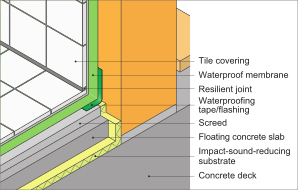
Figure 21. An example of a floating floor on concrete decking. Impact-sound-insulating substrate is inserted underneath and on the sides of the floor, avoiding any direct contact with surrounding building parts. Robust flashing must be installed between the floor and walls because, at this point, the waterproofing is solely dependent on the flashing. For acoustic reasons, a resilient joint has been made between the floor and walls.
Floor |    |
If a floating floor is installed in the bathroom, the watertightness of the joints depends solely on a membrane supported by an impact-sound-reducing substrate. This places heavy demands on the robustness and lifespan of the membrane.
In bathrooms and toilet rooms, substrates with a min. thickness of 8 mm can be used as impact-sound-reducing materials. The impact-sound-reducing substrate, along with the underlying deck, must meet requirements for airborne and impact sound insulation.
Asperities in the deck surface must be significantly shallower
than the thickness of the impact-sound-reducing substrate.
Where acoustic requirements apply, resilient joints should be made between installation components and gullies (see Figure 22).
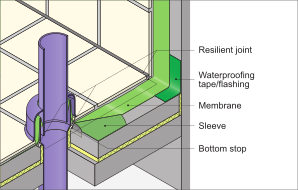
Figure 22. An example of a joint between a floating floor and toilet waste pipe. The discharge pipe is embedded in the concrete deck at the bottom but has no rigid connection to the floating concrete slab at the top. To avoid acoustic transmission paths, elastic sealant is applied between concrete slab and discharge pipe. A collar fitted across the joint between the pipe and the concrete slab ensures a watertight construction. Furthermore, a waterproofing membrane is installed, continuing from the concrete slab across the sleeve and up the pipe.
Floor |    |
2.5.3 Acoustics in New Builds
Water supply installations in dwellings above or below can cause noise from water pipes which intensifies overall noise levels in the dwelling. Noise problems can be reduced or avoided using plumbing shafts as shown in Figures 23 and 24. There is also a requirement for vertical airborne sound insulation. This entails sound-proofing decks such that they are incorporated into plumbing shafts (e.g., with in situ concrete), which will also assists in meeting fire performance requirements.
Wet rooms in residential new builds are discussed in SBi Guidelines 237, Lydisolering mellem boliger – nybyggeri (Sound Insulation Between Dwellings – New Build), Sections 8.3, Vådrum (Wet Rooms) (Rasmussen, Petersen & Hoffmeyer, 2011) and 10, Installationer – lydtransmission og støj (Installations – Acoustic Transmission and Noise).
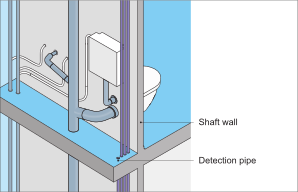
Figure 23. An example of bathroom with plumbing shaft. Using a plumbing shaft will reduce or mitigate noise from the installations and avoid pipe penetrations in the floor. The bottom of the shaft must be watertight and leak detection facilities must be in place to identify any leakages. In this case, leak detection is facilitated by means of detection holes connected to piping continuing down so that leakages are detected in the basement. Alternatively, leak detection can be achieved by making a small opening from the shaft to the wet room, resulting in any leakages being visible on the wet room floor.
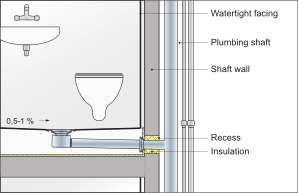
Figure 24. A floor gully embedded in concrete slab. The bathroom is adjacent to a continuous installation shaft. A recess has been made in the shaft wall, so that the discharge pipe can be continued through. The recess is closed off with insulation material around the pipe.
2.5.4 Acoustics and Renovation
Applicable requirements for acoustic insulation of wet rooms in new builds must be complied with if an existing wet room is converted to any significant extent (e.g., if the storey partition deck is changed or if a new wet room is built in an existing building).
If the floor area in a wet room is less than 2.5 m2, the storey partition deck in the wet room is not subject to requirements for impact sound insulation (see the 2010 Building Regulations (Ministry of Transport, Building and Housing, 2010) and DS 490, Sound classification of dwellings (Danish Standards, 2007b)).
For wet rooms with a floor area larger than 2.5 m2, impact sound insulation requirements equal L'n,w ≤ 58 dB. To meet this requirement, a stable, heavy-grade, and rigid substrate must be installed under the floor covering.
Floors can be concreted in the normal way on old timber joist constructions (see Section 3.4, Floors on In-Situ Concrete on Timber Joist Constructions), but a new impact-sound-insulating substrate must be installed before the floor is concreted. There must be clearance between the concrete slab and the existing walls and new walls should be installed on top of the concrete slab. In practice, a poured layer of approx. 55 mm of concrete would be sufficiently heavy and rigid to reduce impact sound if a vibration-reducing layer is installed below it. Furthermore, it is necessary to keep the floating concrete layer clear when fitting installation penetrations. Figure 25 shows an example of how a wet room can be built on a timber joist construction.
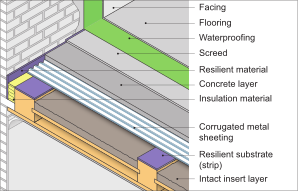
Figure 25. A wet room built on timber joist construction, acoustically enhanced by a floating concrete deck on a substrate of metal sheeting. In this example, impact-sound-insulating material is laid on the joists prior to laying corrugated metal sheets. Joints between the individual metal sheets and between the sheets and the resilient material along the edges of the wet room must be tight to avoid the poured material seeping from the shuttering and destroying the effect of the floating floor. Existing inserts must be retained or possibly replaced by three layers of gypsum board. The remaining cavity can be filled with insulation material.
Floor |    |
Complying with access requirements can be difficult when requirements for impact sound insulation must be observed. For wet room floors within in situ concrete on old timber joist constructions, access will often be via (mobile) ramps.
Hard flooring materials such as tiles and terrazzo, laid directly on an existing concrete deck, will not meet impact-sound-insulation requirements. Renovating or building a wet room larger than 2.5 m2 requires a floating floor. In these cases, floating wet room floors can be constructed with a pressure-distributing layer of concrete poured on a resilient substrate (e.g., mineral wool) keeping clear of the edges, or alternatively, with units of sound-insulating material such as XPS.
Walls in a new wet room doubling as party walls must comply with Building Regulation provisions for airborne sound insulation (see SBi Guidelines 243, Lydisolering mellem boliger – eksisterende byggeri (Sound Insulation Between Dwellings – Existing Buildings), 2.3 Lydbestemmelser i Bygningsreglement 2010 (Sound Regulations in the 2010 Building Regulations) (Rasmussen & Petersen, 2014)).
The most robust solution entails building the bathroom as an independent unit separated from adjoining building parts with impact-sound-reducing material.
Th acoustics in the dwelling below can almost always be improved by installing a suspended ceiling (e.g., with two or three layers of gypsum board, perhaps supplemented by filling out the timber joist construction with mineral wool).
Wet rooms and installations in existing residential buildings are discussed in SBi Guidelines 243, Lydisolering mellem boliger – eksisterende byggeri (Sound Insulation Between Dwellings – Existing Buildings), 9 Tekniske installationer (Technical Installations) (Rasmussen & Petersen, 2014), with specific guidelines for four different building types:
- Section 4.5.3, Bygningstype E1: Ældre muret byggeri med træetageadskillelser (Building Type E1: Old Brick Houses with Timber Storey Partitions)
- Section 5.5.3, Bygningstype E2: Muret byggeri med støbte etageadskillelser (Building Type E2: Brick Houses with Cast Storey Partitions)
- Section 6.5.3, Bygningstype E3: Betonelementbyggeri (Building Type E3: Prefab Concrete Slab Houses)
- Section 7.5.3, Bygningstype E4: Rækkehusbyggeri (Building Type E4: Terraced Houses)